The Movement for Quality Government, or MQG, does some very laudable work. They lobby the courts and other government organs to fight against abuses of power and injustices. They've acted in cases where MKs and ministers have misused funds for personal gain. However, a recent action of theirs is very, very misguided and brings into question their commitment to "quality government."
On January 3, the MQG issued a press release announcing its request to the Prime Minister to remove Prof. Daniel Friedmann from his post as Justice Minister. This was a reaction to Friedmann's recent initiative to change the manner in which high court justices are selected.
The Judicial Selection Committee consists of nine members: 3 sitting justices of the supreme court (including the president of the court), 2 cabinet ministers (including the Justice Minister), 2 Mks (one traditionally being an opposition MK), and 2 members of the Israel Bar Association. Five out of these nine are influenced professionally by the high court. Thus, in practical terms, the sitting President of the high court has a huge degree of influence in deciding who is selected to the high court bench. It's a form of self-selection; the court ends up appointing its own peers and successors with virtually no oversight. Many have pointed out that in recent years appointees have shared very similar political outlooks and, as a group, the justices may be adjudicating some cases on the basis of a political bias.
Prof. Friedmann seeks to minimize this bias by reducing the influence of sitting judges regarding who will succeed them. Under his proposal, the selection committee would be the same as before except for two changes: there would be one less high court justice and three additional committee members. The additional committee members would be a former judge, an academician appointed by the PM, and an academician appointed by the Council on Higher Learning. Friedmann also proposed search committees to gather information on prospective high court candidates. Essentially, Friedmann wants the process of selecting high court justices to be more transparent and to enable wider public participation.
MQG's response? “Prof. Friedmann's new proposal to change the manner of choosing judges is another instance of trying to harm the independence and the stature of the high court.” Well, independence to judge is not the same as omnipotence to rule. Once appointed, high court justices are not subjected to performance reviews. They may be forcibly removed if they are convicted of crimes or treason or if they become incapacitated; otherwise, they are guaranteed the post until the age of 70. One of the few ways of curtailing the high court from abusing its power is by denying its members from forming an exclusive, self-selecting club.
Is Prof. Friedmann harming the “stature” of the high court? Many in Israel feel that the court's stature has suffered from a perceived political bias and that the court has used its judicial muscle to “legislate from the bench.” Two major respected figures in American jurisprudence, Justice Robert Bork and Justice Richard Posner, have commented that the “activist” nature of Israel's high court actually has harmed its prestige. The Movement for Quality Government seems to be confusing judicial brawn for judicial brain; brute power to self-select and to commandeer authority beyond its judicial mandate does not engender respect. Restraint from activism and a respect for government "of the people" engenders democratic respect.
The MQG's statement bemoans that, under Friedmann's proposal, “the government will have a near majority presence on the selection committee, creating a situation of politicization in the choice of the judges.” With the stakes involved, there has never been a way to make the process apolitical. Judges are not immune to political bias. Under Aharon Barak, the high court became a central actor in the political arena. Politically activist in nature, it increasingly exercised a self-acquired judicial review of legislation and ventured beyond its domestic judicial mandate, even into issues of cross-border defense and foreign policy.
Friedmann's approach has not been perfect. His call to limit the scope of the court's mandate to internal judicial matters is reasonable; however, his proposal to exclude plea bargains from high court review is dangerously inappropriate. As Yitzhak Klein of the Israel Policy Center indicated, it is wrong to give any appointed official the right to make decisions about citizens' liberties without judicial checks and balances. While he does not go far enough in preventing self-selection on the high court, Friedmann's proposal on this issue is a step in the right direction. Shelanu's take is that sitting justices should have no authoritative standing in the selection of their brethren to the bench.
Regarding the judicial selection committee, the Movement for Quality Government should reacquaint itself with its self-proclaimed goal. Enhancing the quality of government is best served with mechanisms that competitively select for excellence on the one hand and check the abuse of power on the other. The judiciary is a government branch and requires the oversight of checks and balances every bit as much as the legislative and executive branches. For high court judges to have the power to select their own peers and successors, the pinnacle of the powerful judicial branch, without effective oversight, is clearly not "government of the people." It assumes that supreme court justices themselves are apolitical and immune to political influences; this is a dangerously naive assumption. The corrupting influence of absolute power applies to high court justices as well. Ignoring this imperils democratic values because it invites abuses of power; a tyranny of the judiciary tyranny nonetheless. The Movement for Quality Government should consider these words of Thomas Jefferson, written in the twilight of a life filled with brilliant achievements in the cause of democracy, including his authorship of the Declaration of Independence.
"At the establishment of our constitutions, the judiciary bodies were supposed to be the most helpless and harmless members of the government. Experience, however, soon showed in what way they were to become the most dangerous; that the insufficiency of the means provided for their removal gave them a freehold and irresponsibility in office; that their decisions, seeming to concern individual suitors only, pass silent and unheeded by the public at large; that these decisions, nevertheless, become law by precedent, sapping, by little and little, the foundations of the constitution, and working its change by construction, before any one has perceived that that invisible and helpless worm has been busily employed in consuming its substance. In truth, man is not made to be trusted for life, if secured against all liability to account."
Thomas Jefferson, letter to Monsieur A. Coray, Oct 31, 1823
If we make it difficult to remove high court justices, we must be extremely careful whom we empower to decide on their selection. The judicial selection process must become more transparent and better checked.
Wednesday, January 16, 2008


Thursday, December 20, 2007
Damning the majority... again
Yesterday, I sat in, again, on the Constituion, Justice, and Law Committee. The topic of the session was how the Knesset passes the budget. The first proposal stated, "A proposed law will pass, when dealing with budgetary issues, with at least 50 votes among Knesset Members." In other words, a simple majority is not sufficient. There could be 49 votes in favor, zero votes opposed and 71 abstentions, and the budget would not pass. From the other extreme, as worded, the 50 votes in favor of a budget proposal would pass even with an opposition of 70, as the proposal does not mention the word "majority." When I asked whether this last point was a possibility, committee chair Menachem Ben-Sasson referred me to small print in the footnotes of the bill, which states, "this majority is necessary in the first reading, the second reading, and the third reading..." A key question... Is the concept of majority not central enough, in principle and in practice, to the passage of laws the it should not be clearly specified in something so crucial as a protocol for budgetary legislation? Ben-Sasson instructed his legislative law aide to look into the matter.
This is another instance in which the concept of majority rule is either neglected or perverted. In the United States, both houses of Congress pass budget bills on the basis of simple majority. For one thing, it is unlikely that a significant number of U.S. legislators would not weigh in and vote on a budget proposal. Their constituents would not be very forgiving. So, what is the significance of the proviso of a majority consisting of at least 50 MKs? In the parliamentary coalition system that is the shame and the bane of Israeli governance, the threshold guarantees that narrow interests would be courted in order for the party with executive power to pass a budget. In the current system, minority interests and the opposition parties don't even have to coordinate a "nay" vote to defeat a budget they deem unacceptable. The implication, once again, is the very "European" Israeli perspective of not considering the national population as a single, diverse "public," but rather as separate interest groups, whose fractionating influence continues to prevent the development of a mainstream, public political majority.
This is another instance in which the concept of majority rule is either neglected or perverted. In the United States, both houses of Congress pass budget bills on the basis of simple majority. For one thing, it is unlikely that a significant number of U.S. legislators would not weigh in and vote on a budget proposal. Their constituents would not be very forgiving. So, what is the significance of the proviso of a majority consisting of at least 50 MKs? In the parliamentary coalition system that is the shame and the bane of Israeli governance, the threshold guarantees that narrow interests would be courted in order for the party with executive power to pass a budget. In the current system, minority interests and the opposition parties don't even have to coordinate a "nay" vote to defeat a budget they deem unacceptable. The implication, once again, is the very "European" Israeli perspective of not considering the national population as a single, diverse "public," but rather as separate interest groups, whose fractionating influence continues to prevent the development of a mainstream, public political majority.
Sunday, October 28, 2007
When Good People Get It Wrong
Sarah Honig is one of my very, very favorite columnists... anywhere. When it comes to pinning the the pinheads who, through greed or sheer incompetence, place our security at risk and violate our democracy, nobody does it as eloquently as Sarah. So, when I read her column in the Jerusalem Post almost two weeks ago ( Another Tack: I am the state, 18 October 2007), I felt surprised and disappointed. She described the movement towards a constituency system as essentially a naive, falsely-euphoric "quick-fix" approach.
Nobody I know who works towards instituting a majoritarian system here has any illusions of how quick it might be changed, or how it might fix all of our problems. This isn't like some magic tonic that lets us be "just like America." Those of us pushing for a constituency system have a very basic belief in some intrinsic values:
These are values that not only guide a system of governance, they transform and characterize a nation. It's a question of commitment to the principle that we must make national decisions as a single nation. Those who do not want to be part of that nation will just have to make an adjustment, either by participating and thereby throwing in their lot with the mainstream, trying to influence from within by appealing to the majority, or by disenfranchising themselves and removing themselves from the process of influencing policy. Proportional systems enable some factions, and their MKs, to openly manipulate our political system without committing to its national well-being. This alone should make Sarah an enthusiastic advocate of a constituency system.
Sarah hinted that Israeli corruption in gerrymandering would result in single-party hegemony. Well, we live under a hegemony right now: the hegemony of a sacred status quo among the power elite that has no association in the public. Yes, gerrymandering is a constant challenge in constituency systems, however there are political mechanisms in constituency systems that can address this issue.
The question is, what motivates the public to demand and produce political excellence? What system produces and benefits patriots who serve a true national vision? Not the proportional system, with its built-in sectarian entitlements; the majoritarian system does, because it pushes the public to form a mainstream majority.
Sarah's blames Israelis for just voting poorly. We Israelis, who vote for parties like Gil (the pensioners' party), or the Green Party, or other parties with narrow interest, just don't take voting seriously. She fails to consider that our proportional-parliamentary system, with its post-election horsetrading, makes it impossible for voters for major parties to actually know whom or what they are supporting with their votes. A person's vote becomes a fungible resource of a party central committee, which acts as the citizen's proxy. The Israeli voter is vulnerable to trendy whims because such a system will not reward individual excellence or integrity. Coalitions effectively end up making liars out of each elected leadership. Tragically, the only parties that can be relied upon to stick to their election promises tooth-and-nail are those narrow-interest parties.
Elections are a major part of a democracy's sensory-cognitive center, the mechanism that provides a living vertebrate with reliable sensory information and efficient response functions. It should be clear to all of us, especially Sarah, that our system makes us politically aphasic; we are unable to translate our national will into a choice that can be reliably perceived or expressed. Give us a system in which individuals commit their names and careers to campaign platforms, one that actually empowers the winners to execute on those promises, and we Israelis will make good decisions. It's not the people, Sarah, it's the system.
Nobody I know who works towards instituting a majoritarian system here has any illusions of how quick it might be changed, or how it might fix all of our problems. This isn't like some magic tonic that lets us be "just like America." Those of us pushing for a constituency system have a very basic belief in some intrinsic values:
- the individual accountability to the public that is possible only when one is directly elected
- the tradition of real debate and shared destiny, across social divides. that occurs in majoritarian systems
- the priority of public service - to a single, national public - over the sectarian patronization institutionalized by proportionalism
- that an individual voter should have the last word to express his preference for who, specifically, will influence law and policy in his name; that no vote is transferable by anyone other than the voter himself.
- that minorities must not be able to force a majority to act against that majority's own interests.
These are values that not only guide a system of governance, they transform and characterize a nation. It's a question of commitment to the principle that we must make national decisions as a single nation. Those who do not want to be part of that nation will just have to make an adjustment, either by participating and thereby throwing in their lot with the mainstream, trying to influence from within by appealing to the majority, or by disenfranchising themselves and removing themselves from the process of influencing policy. Proportional systems enable some factions, and their MKs, to openly manipulate our political system without committing to its national well-being. This alone should make Sarah an enthusiastic advocate of a constituency system.
Sarah hinted that Israeli corruption in gerrymandering would result in single-party hegemony. Well, we live under a hegemony right now: the hegemony of a sacred status quo among the power elite that has no association in the public. Yes, gerrymandering is a constant challenge in constituency systems, however there are political mechanisms in constituency systems that can address this issue.
The question is, what motivates the public to demand and produce political excellence? What system produces and benefits patriots who serve a true national vision? Not the proportional system, with its built-in sectarian entitlements; the majoritarian system does, because it pushes the public to form a mainstream majority.
Sarah's blames Israelis for just voting poorly. We Israelis, who vote for parties like Gil (the pensioners' party), or the Green Party, or other parties with narrow interest, just don't take voting seriously. She fails to consider that our proportional-parliamentary system, with its post-election horsetrading, makes it impossible for voters for major parties to actually know whom or what they are supporting with their votes. A person's vote becomes a fungible resource of a party central committee, which acts as the citizen's proxy. The Israeli voter is vulnerable to trendy whims because such a system will not reward individual excellence or integrity. Coalitions effectively end up making liars out of each elected leadership. Tragically, the only parties that can be relied upon to stick to their election promises tooth-and-nail are those narrow-interest parties.
Elections are a major part of a democracy's sensory-cognitive center, the mechanism that provides a living vertebrate with reliable sensory information and efficient response functions. It should be clear to all of us, especially Sarah, that our system makes us politically aphasic; we are unable to translate our national will into a choice that can be reliably perceived or expressed. Give us a system in which individuals commit their names and careers to campaign platforms, one that actually empowers the winners to execute on those promises, and we Israelis will make good decisions. It's not the people, Sarah, it's the system.
Tuesday, September 18, 2007
My letter to today's Jerusalem Post
A letter of mine, clarifying my perspective regarding the direct election of the Prime Minister in the 1990s, was published in today's Jerusalem Post. You can read it at the following web address.
http://www.jpost.com/servlet/Satellite?cid=1189411413619&pagename=JPost/JPArticle/Printer
It reads as follows.
For real reform
Sir, - Kudos to Gil Hoffman for his recent pieces on electoral reform efforts ("Power to the people" (September 7) and its follow-up on Shelanu ("New electoral reform," September 10). Articles like these should remind us, especially those who feel alienated and helpless in Israel's quagmire of poor governance, that the source of political power in any democracy is the public. Citizen activism can make a crucial difference.
I would like to clarify one issue on the reporting of my perspective: While I do believe that the direct election of every Knesset member is vital, I don't claim that its absence primarily caused the direct election of the prime minister to fail. That effort at reform was acutely flawed because of a different combination of incompatible principles in action.
Individual accountability and executive discretionary authority, facilitated by the direct election of the prime minister, were trumped by a coalition system of executive power-sharing meant to deny that very same discretion to the prime minister. Once Binyamin Netanyahu and Ehud Barak were directly elected by the public, the Knesset could circumvent the public's choice by bringing down the government in a vote of no-confidence at any time thereafter, upon a coalition's weakening. This constant threat forced these PMs to prioritize coalition demands over the public interest and campaign promises. As non-separate entities with shared personnel and management, either the legislative branch hobbled the functioning of the executive branch, or vice versa.
A presidential executive system, effectively separating the legislative from the executive branch, would go a long way toward rectifying this problematic situation. It should be an integral part in a comprehensive change, including the direct election of legislators, to rehabilitate our system of government into one that truly serves the interests of the Israeli public.
MICHAEL JAFFE
Director, Shelanu
Zichron Ya'akov
http://www.jpost.com/servlet/Satellite?cid=1189411413619&pagename=JPost/JPArticle/Printer
It reads as follows.
For real reform
Sir, - Kudos to Gil Hoffman for his recent pieces on electoral reform efforts ("Power to the people" (September 7) and its follow-up on Shelanu ("New electoral reform," September 10). Articles like these should remind us, especially those who feel alienated and helpless in Israel's quagmire of poor governance, that the source of political power in any democracy is the public. Citizen activism can make a crucial difference.
I would like to clarify one issue on the reporting of my perspective: While I do believe that the direct election of every Knesset member is vital, I don't claim that its absence primarily caused the direct election of the prime minister to fail. That effort at reform was acutely flawed because of a different combination of incompatible principles in action.
Individual accountability and executive discretionary authority, facilitated by the direct election of the prime minister, were trumped by a coalition system of executive power-sharing meant to deny that very same discretion to the prime minister. Once Binyamin Netanyahu and Ehud Barak were directly elected by the public, the Knesset could circumvent the public's choice by bringing down the government in a vote of no-confidence at any time thereafter, upon a coalition's weakening. This constant threat forced these PMs to prioritize coalition demands over the public interest and campaign promises. As non-separate entities with shared personnel and management, either the legislative branch hobbled the functioning of the executive branch, or vice versa.
A presidential executive system, effectively separating the legislative from the executive branch, would go a long way toward rectifying this problematic situation. It should be an integral part in a comprehensive change, including the direct election of legislators, to rehabilitate our system of government into one that truly serves the interests of the Israeli public.
MICHAEL JAFFE
Director, Shelanu
Zichron Ya'akov
Tuesday, September 11, 2007
Jerusalem Post Follows Up on.... US!!
After I sent a quick email to Jerusalem Post reporter Gil Hoffman, (who penned last Friday's piece on political reform, "Power to the people,") Gil called me on the phone and interviewed me. That interview was reported in today's Jerusalem Post in an article called, "New electoral reform movement Shelanu launches plan to directly elect 120 MKs." You can read it at the following web address.
http://www.jpost.com/servlet/Satellite?cid=1188392576615&pagename=JPost/JPArticle/Printer
The article was short and to the point. While he was a bit fuzzy about my views on the the direct election of the prime minister, I am very grateful for the opportunity he's given me. Now, I really have to get that amutah (non-profit organization) application finished and submitted!
http://www.jpost.com/servlet/Satellite?cid=1188392576615&pagename=JPost/JPArticle/Printer
The article was short and to the point. While he was a bit fuzzy about my views on the the direct election of the prime minister, I am very grateful for the opportunity he's given me. Now, I really have to get that amutah (non-profit organization) application finished and submitted!
Friday, September 07, 2007
In Today's Jerusalem Post
Today's Jerusalem Post included an article in the "In Focus" magazine section, titled "Power to the people," dealing with currents and undercurrents of electoral reform. You can read it at the following address:
http://www.jpost.com/servlet/Satellite?cid=1188392551714&pagename=JPost/JPArticle/Printer
Among other things, the article describes the work of the people at CEPAC. CEPAC is the Citizens' Empowerment Public Action Committee. CEPAC advocates, among other reforms, the direct election of 60 MKs (half the Knesset) in 60 single-representative districts. The CEPAC web site's "Background and Goals" page, at http://www.cepac.org.il/Site/Site_ViewPage.asp?id=3, states
"Ideally we would like all 120 M.K.'s elected by district (perhaps a future goal) but realistically we feel that the 60-60 split has the best chance of being adopted."
Just because an alternative is easier to achieve in the short term doesn't mean it is the better alternative. CEPAC has good intentions and good people working for it; I know and respect their leaders. However, compromising on vital principals of governance in order to achieve quicker results is not a winning strategy. Such a compromise may nullify any potential gains in public service that these good people are working so hard to achieve. It's worth waiting a while longer, working a little harder, to get it right. It's worth being stubborn.
We, at Shelanu, don't think that the public should have to compromise on principles of true representation. We certainly don't owe senior members of the major parties guaranteed job security as MKs. We believe that all members of Knesset should be elected by the same criteria. We believe that the public should have the last and only say in how it wants to be served, in which form of representative democracy. We believe that the public can bring about the changes it wants if it well organized around focused, principled goals.
We have good reason to believe that such partial compromises will not result in progress towards our goal of the direct election of all Knesset members. When the influence of directly elected MKs is diluted, such that they constitute only half of the Knesset, narrow interests and corrupting influences have a good chance of derailing legislation in the public interest. In the past, we saw an important reform, the direct and separate election of the prime minister, become tainted and then abandoned because of a tragic "compromise" of its applied principle; the cause of government reform was set back over a decade.
Real reforms don't occur very often. If we're going to make the effort to reshape Israel's political culture, there is no point in aiming for the mediocre, no point in gratefully accepting what today's failed legislators are willing to offer. An unsatisfied employer does not let a mediocre employee decide how to run the business. It is time to get serious about reform, time to decide what we, the People, want and pursue it. It doesn't take a PhD to understand the principles of good governance. It does take steadfast determination to achieve worthwhile change.
http://www.jpost.com/servlet/Satellite?cid=1188392551714&pagename=JPost/JPArticle/Printer
Among other things, the article describes the work of the people at CEPAC. CEPAC is the Citizens' Empowerment Public Action Committee. CEPAC advocates, among other reforms, the direct election of 60 MKs (half the Knesset) in 60 single-representative districts. The CEPAC web site's "Background and Goals" page, at http://www.cepac.org.il/Site/Site_ViewPage.asp?id=3, states
"Ideally we would like all 120 M.K.'s elected by district (perhaps a future goal) but realistically we feel that the 60-60 split has the best chance of being adopted."
Just because an alternative is easier to achieve in the short term doesn't mean it is the better alternative. CEPAC has good intentions and good people working for it; I know and respect their leaders. However, compromising on vital principals of governance in order to achieve quicker results is not a winning strategy. Such a compromise may nullify any potential gains in public service that these good people are working so hard to achieve. It's worth waiting a while longer, working a little harder, to get it right. It's worth being stubborn.
We, at Shelanu, don't think that the public should have to compromise on principles of true representation. We certainly don't owe senior members of the major parties guaranteed job security as MKs. We believe that all members of Knesset should be elected by the same criteria. We believe that the public should have the last and only say in how it wants to be served, in which form of representative democracy. We believe that the public can bring about the changes it wants if it well organized around focused, principled goals.
We have good reason to believe that such partial compromises will not result in progress towards our goal of the direct election of all Knesset members. When the influence of directly elected MKs is diluted, such that they constitute only half of the Knesset, narrow interests and corrupting influences have a good chance of derailing legislation in the public interest. In the past, we saw an important reform, the direct and separate election of the prime minister, become tainted and then abandoned because of a tragic "compromise" of its applied principle; the cause of government reform was set back over a decade.
Real reforms don't occur very often. If we're going to make the effort to reshape Israel's political culture, there is no point in aiming for the mediocre, no point in gratefully accepting what today's failed legislators are willing to offer. An unsatisfied employer does not let a mediocre employee decide how to run the business. It is time to get serious about reform, time to decide what we, the People, want and pursue it. It doesn't take a PhD to understand the principles of good governance. It does take steadfast determination to achieve worthwhile change.
Saturday, September 01, 2007
Party for Sale
The travesty that is Israeli democracy has hit a new low in absurdity. On Tuesday, Ehud Barak announced that the Labor party would not be leaving the government coalition. Might this have something to do with any feeling of solidarity between Labor and Kadima? Is this a case of uncharacteristically galant political non-partisanship towards addressing national issues? Apparently not.
Barak explained that the Labor party must stay in the government because it is too broke to run in an election. "We cannot win an election as a charity case," Barak told Labor's executive committee. Under his leadership, Barak promised that the finanacial situation would be rectified, "and after that face the political challenge ahead..." While campaigning for the leadership of Labor, Barak promised that he would inititate early elections upon release of the Winograd Committee Report on last summer's Lebanon War.
Two troublesome and inescapable conclusions arise from Barak's financial justification. First, never has it been so clear that political principles are for sale in Israel. That Israelis tolerate it, and individuals still vote for parties with leaders that flaunt it, is good reason to worry about Israel's public political culture. Second, there is an easily imagined possibility that Barak plans to exact financial advantages from his position of leverage in the coalition. Might public tax money end up paying for the financial rehabilitation of the Labor party?
Not only is Labor's bank account empty, so are its ethical principles and the promises of its leadership. This isn't Labor's problem alone, though. In this political system, with proportionalism denying the direct influence of the public in the selection of representatives and leaders, the game is musical chairs. Do whatever you can to maintain your seat; how you do it is unimportant. Lots of Israeli voters want to vote for "a winner;" what many don't realize is that by electing the party leadership choice, they are usually electing mediocrity. So, while they might be voting for proportionally elected "winners," the resulting mediocre, corrupt, inept public service the voters eventually receive makes them, and all of us really, losers.
Barak explained that the Labor party must stay in the government because it is too broke to run in an election. "We cannot win an election as a charity case," Barak told Labor's executive committee. Under his leadership, Barak promised that the finanacial situation would be rectified, "and after that face the political challenge ahead..." While campaigning for the leadership of Labor, Barak promised that he would inititate early elections upon release of the Winograd Committee Report on last summer's Lebanon War.
Two troublesome and inescapable conclusions arise from Barak's financial justification. First, never has it been so clear that political principles are for sale in Israel. That Israelis tolerate it, and individuals still vote for parties with leaders that flaunt it, is good reason to worry about Israel's public political culture. Second, there is an easily imagined possibility that Barak plans to exact financial advantages from his position of leverage in the coalition. Might public tax money end up paying for the financial rehabilitation of the Labor party?
Not only is Labor's bank account empty, so are its ethical principles and the promises of its leadership. This isn't Labor's problem alone, though. In this political system, with proportionalism denying the direct influence of the public in the selection of representatives and leaders, the game is musical chairs. Do whatever you can to maintain your seat; how you do it is unimportant. Lots of Israeli voters want to vote for "a winner;" what many don't realize is that by electing the party leadership choice, they are usually electing mediocrity. So, while they might be voting for proportionally elected "winners," the resulting mediocre, corrupt, inept public service the voters eventually receive makes them, and all of us really, losers.
Friday, June 08, 2007
Back in Sderot: A Day With Lev Echad
Last Wednesday, I returned to Sderot to volunteer with Lev Echad. It was an experience that I highly recommend to anyone and everyone who can make the trip down. Unlike my trip the week before, I didn't think of this trip as a fact-finding, dangerous excursion to the city where Kassams fall almost daily. I went to help the people of Sderot.
I arrived at Lev Echad's compound at around one in the afternoon. A short while later, I was briefed about what to do if a condition red was sounded. When outside, find a wall that faces east and crouch against it. If you're near any family dwelling, don't knock, just enter and find a shelter or fortified doorway. The idea of entering a home uninvited can be strange or uncomfortable for an outsider to contemplate. For the locals and volunteers who have been in Sderot for a week or more, the practice is second nature.
My first assignment of the day was to respond to a request by a 20 year-old woman to help her mother, who suffered from extreme anxiety, to seek help. We arrived at the address around two in the afternoon. My partner, a yeshivah student, was reluctant to knock on the door as it was siesta time. Knowing when the call came in, I insisted. The mother opened the door and made it clear that we were most welcome to enter. She set up some refreshments for us despite our protestations; we were there for her. Sderot's people are so happy and grateful to have others visit them. They are grateful to see others stand beside them to face the fallout of the government's lack of moral clarity, to face the inability of so-called leaders to deal decisively with outright, deadly attacks.
Her daughter joined us shortly and after about twenty minutes her husband arrived from his job in the municipality. Sitting in the salon, talking about family and the situation in the country, the mother seemed at ease. However, when the topic of going outside came up, she seemed to clench in from the center of her chest. We spoke about her anxiety. For weeks, she had not left the house, had not shopped for food or worked.
We discussed our views on the source of Israel's apparent national paralysis in dealing with its problems, the disconnection between the people and those ineffectively chosen to ineffectively govern. While discussing this topic, a condition red was sounded and we huddled under a reinforced doorway. We left about a half-hour later.
My next assignment found me on the other side of Sderot about two hours later. That evening, an information session was organized to showcase government officials and policy makers. A mother of five children needed a babysitter so that she might attend. The hour we were supposed to spend there turned into two. The children were absolutely delightful. A two year old played for a while and then went to sleep. The other children were happy to watch a DVD. We talked for a little while about what it was like to go to the park.
When the mother came back home, she spoke about how the government officials said nothing of importance. The main message was that the rockets would continue. Get used to it. It was simultaneously a disgrace and an outrage.
The mother drove us back to the Lev Echad compound, where volunteers were preparing for the nightly march throughout Sderot. Once underway, the volunteers waved flags and bear torches, singing and dancing from one neighborhood to the next. They sang Hebrew songs, psalms, and "Sderot, we love you." People would come to the windows. Some would come down from their apartments to sing and dance along. There were embraces as volunteers and citizens became reacquainted from earlier assignments. In parking lots, we passed cars with shattered windshields and holes peppered throughout their steel bodies, damaged by Kassams. We walked along roadbeds gouged and scarred from shrapnel.
The parade lasted over two hours. By the time the volunteers arrived at the school where they slept it was almost eleven in the evening. We were then informed that Elya had arranged for a bus to take us to the beach at Ashkelon for a midnight swim. So, at half past midnight, I was swimming in the Mediterranean with a bunch of pre-army and post-army kids, some younger than Tamar. We could see the lights of Gaza. Swimming about fifty yards from the shore, I felt I was swimming in a photographic negative of a world.
When I came out of the water, Elya had just gotten the chance to swim. As we passed, he asked me, "What do you think of them?" "Very impressive," I replied. These young people, and all who came down to support Sderot, these people understood what is important, what is crucial. When I lamented that more people weren't volunteering and visiting Sderot that Wednesday, Elya informed me that it was a light turnout relative to the norm. On weekends, numerous busloads of people, some privately arranged, some through yeshivahs and communities, came to spend Shabbat with the people of Sderot. Lev Echad arranges to house them and feed them.
We arrived back at the school at two-thirty, pre-dawn. After waking several hours later, I had one assignment: to help a mother convince her eight year old daughter to go to school. It turned out that the daughter was not overly-anxious, she was exhausted. She had slept only two hours the night before, which was normal for her. She had health problems and the rockets aggravated her sleeping patterns. We sat with mother and daughter for a while and returned to the compound.
I hope to return to Sderot in the coming weeks, spending two or three days at a time helping out. It's good work, good people, both volunteers and Sderot citizens. It's not only about the responsibilities to one's country and countrymen. It's about the the feeling of reconciling who we are as Jews and free people facing down barbarism.
Lev Echad is doing great work. If there is a drawback, it is that Lev Echad does what it does so well that the government might not feel the need and responsibility to do all that it should in relieving Sderot and eliminating the threat from Gaza. So, while Sderot is justifiably grateful to Lev Echad, I hope their indignation towards their government of mediocrity remains strong and vociferous. Until we have a system that rewards achievement and punishes failure, this outrage of a neglected public must not abate.
You can contact Lev Echad at 054-7587462/3.
I arrived at Lev Echad's compound at around one in the afternoon. A short while later, I was briefed about what to do if a condition red was sounded. When outside, find a wall that faces east and crouch against it. If you're near any family dwelling, don't knock, just enter and find a shelter or fortified doorway. The idea of entering a home uninvited can be strange or uncomfortable for an outsider to contemplate. For the locals and volunteers who have been in Sderot for a week or more, the practice is second nature.
My first assignment of the day was to respond to a request by a 20 year-old woman to help her mother, who suffered from extreme anxiety, to seek help. We arrived at the address around two in the afternoon. My partner, a yeshivah student, was reluctant to knock on the door as it was siesta time. Knowing when the call came in, I insisted. The mother opened the door and made it clear that we were most welcome to enter. She set up some refreshments for us despite our protestations; we were there for her. Sderot's people are so happy and grateful to have others visit them. They are grateful to see others stand beside them to face the fallout of the government's lack of moral clarity, to face the inability of so-called leaders to deal decisively with outright, deadly attacks.
Her daughter joined us shortly and after about twenty minutes her husband arrived from his job in the municipality. Sitting in the salon, talking about family and the situation in the country, the mother seemed at ease. However, when the topic of going outside came up, she seemed to clench in from the center of her chest. We spoke about her anxiety. For weeks, she had not left the house, had not shopped for food or worked.
We discussed our views on the source of Israel's apparent national paralysis in dealing with its problems, the disconnection between the people and those ineffectively chosen to ineffectively govern. While discussing this topic, a condition red was sounded and we huddled under a reinforced doorway. We left about a half-hour later.
My next assignment found me on the other side of Sderot about two hours later. That evening, an information session was organized to showcase government officials and policy makers. A mother of five children needed a babysitter so that she might attend. The hour we were supposed to spend there turned into two. The children were absolutely delightful. A two year old played for a while and then went to sleep. The other children were happy to watch a DVD. We talked for a little while about what it was like to go to the park.
When the mother came back home, she spoke about how the government officials said nothing of importance. The main message was that the rockets would continue. Get used to it. It was simultaneously a disgrace and an outrage.
The mother drove us back to the Lev Echad compound, where volunteers were preparing for the nightly march throughout Sderot. Once underway, the volunteers waved flags and bear torches, singing and dancing from one neighborhood to the next. They sang Hebrew songs, psalms, and "Sderot, we love you." People would come to the windows. Some would come down from their apartments to sing and dance along. There were embraces as volunteers and citizens became reacquainted from earlier assignments. In parking lots, we passed cars with shattered windshields and holes peppered throughout their steel bodies, damaged by Kassams. We walked along roadbeds gouged and scarred from shrapnel.
The parade lasted over two hours. By the time the volunteers arrived at the school where they slept it was almost eleven in the evening. We were then informed that Elya had arranged for a bus to take us to the beach at Ashkelon for a midnight swim. So, at half past midnight, I was swimming in the Mediterranean with a bunch of pre-army and post-army kids, some younger than Tamar. We could see the lights of Gaza. Swimming about fifty yards from the shore, I felt I was swimming in a photographic negative of a world.
When I came out of the water, Elya had just gotten the chance to swim. As we passed, he asked me, "What do you think of them?" "Very impressive," I replied. These young people, and all who came down to support Sderot, these people understood what is important, what is crucial. When I lamented that more people weren't volunteering and visiting Sderot that Wednesday, Elya informed me that it was a light turnout relative to the norm. On weekends, numerous busloads of people, some privately arranged, some through yeshivahs and communities, came to spend Shabbat with the people of Sderot. Lev Echad arranges to house them and feed them.
We arrived back at the school at two-thirty, pre-dawn. After waking several hours later, I had one assignment: to help a mother convince her eight year old daughter to go to school. It turned out that the daughter was not overly-anxious, she was exhausted. She had slept only two hours the night before, which was normal for her. She had health problems and the rockets aggravated her sleeping patterns. We sat with mother and daughter for a while and returned to the compound.
I hope to return to Sderot in the coming weeks, spending two or three days at a time helping out. It's good work, good people, both volunteers and Sderot citizens. It's not only about the responsibilities to one's country and countrymen. It's about the the feeling of reconciling who we are as Jews and free people facing down barbarism.
Lev Echad is doing great work. If there is a drawback, it is that Lev Echad does what it does so well that the government might not feel the need and responsibility to do all that it should in relieving Sderot and eliminating the threat from Gaza. So, while Sderot is justifiably grateful to Lev Echad, I hope their indignation towards their government of mediocrity remains strong and vociferous. Until we have a system that rewards achievement and punishes failure, this outrage of a neglected public must not abate.
You can contact Lev Echad at 054-7587462/3.
Tuesday, May 29, 2007
Sderot: Afternoon in a Ghost Town
It's hard to imagine that the town of Sderot, bordering the northeast tip of Gaza, is only an hour's drive south of cosmopolitan Tel Aviv, forty-five minutes if you avoid rush hour and liberally interpret speed limits. It's like driving from Manhattan to Atlantic Beach, Miami to Hallandale, Malibu to Pasadena. For the past seven years, the people of Sderot, and anyone unfortunate enough to be in the wrong place at the wrong time, have lived under the shadow of Kassam rocket attacks. I imagine that if rockets fell on any of these places, the entire population within a two hundred mile radius would be in an uproar. Six years of Kassams in Sderot has not seemed to spark much in Tel Aviv.
 Last Monday, I made the trip from Zichron Yaakov, officially the "north" of the country, in a little under two hours. Towards the end of the drive, right before turning east on route 34, I saw the zeppelin-shaped reconnaissance balloon hovering over the southern edge of the city of Ashkelon. The balloon carries a sophisticated array of cameras and sensory equipment. Looking at it swaying in the wind, it seemed simultaneously ominous and flimsy, a ridiculous-looking, blow-up sentry that is an integral part of what protects us.
I arrived shortly after one in the afternoon. Few cars were in transit on the town's streets. I needed directions to get to the office of Noam Bedein, who runs the Sderot Media Center, which provides foreign journalists with background information and news about the continuous assault on Sderot. After spending ten minutes mentally reviewing the internet-sourced road directions, I parked and walked up the street looking for a local to guide me. After a few moments, I flagged a passing car. Before answering my requsst for directions, the driver briefed me on what to do if and when a "Tzeva Adom," a "red alert," sounded. I asked when the last one had sounded and he looked at me incredulously. Ten minutes earlier, just as I had entered the town limits. I made a mental note to keep the car stereo turned low or off. The announcement of a tzeva adom signals an imminent Kassam explosion, within 20 seconds. I later learned that most Kassams are launched in the morning hours between six and nine, and then at twilight, between seven and ten in the evening. This is done to coincide with Israel's broadcast television news cycle.
Kassam rockets are unpredictable, lethal projectiles capable of travelling up to 10km, around 6 miles. They can carry up to 10kg (22 lb.) of explosive payload. A major portion of this payload is devastating anti-personnel shrapnel: nails, bolts, and other packed bits of sharp metal intended to pierce skin, muscle, bone, and vital organs. These are not weapons intended to damage property or infrastructure; they are meant to injure, kill, and maim civilians. Kassams are meant to terrorize and after seven years of almost daily bombardment, many people in Sderot are indeed terrorized. Children are afraid to go to school and adults fear going outside to go to work.
Israeli defense officials categorize Kassams as "more a psychological rather than physical threat." Though Kassams alone will not physically harm the great majority of citizens in Sderot, their capacity for physical devastation and death is not subject to debate. At least eleven Israelis have lost their lives to Kassam rockets.
What is debatable is whether Israel's artificially-proportionally elected government is performing its mandate of responsibility for safeguarding Israel's citizens. The government of Ehud Olmert has promised a firm response to the Kassams, however even after the latest deaths most talk is of reinforcing structures in Sderot. Mayor Eli Moyal is quick to point out that injuries and deaths from Kassams occur outside. Moyal and his constituents want their national government to eliminate the threat of Kassams period. This means stopping the terrorists who launch the rockets. Unfortunately, there is no way of stopping the terrorists without insulting the politically correct sensibilities of Ehud Olmert's coalition partners, without contradicting the government's commitment to "disengagement."
I arrived at the Sderot Media Center, located at 12 Rakefet Street, nestled in a Dutch style subdivision of private houses. The enterprise was established eight months ago by Noam Bedein, a 24 year-old Ben-Gurion University student who hasn't been to classes much lately, thanks to his work in Sderot and the university student union strike. After serving in the IDF on the Lebanese border, Noam spent a year backpacking Asia. A budding photographer, Noam's prints of bamboo Thai countryside, snowcapped Tibetan peaks, Buddhist monks walking with tigers, and Sderot adorn his living room. If there is a thread that connects them, perhaps it's the beauty and savagery that exist in the real world, beyond the margins of our collective attention. In the near future, he will exhibit photographs and drawings on a more immediate subject, the terror and fear etched in the faces of the citizens of Sderot. Noam and his coworkers try to keep attention riveted on Sderot and provide essential details to help describe what, almost anywhere else, would be an unthinkable situation. An otherwise peaceful town absorbs daily rocket attacks from a clearly identified neighboring territory. The attacks are sanctioned by the neighboring local government, while the sovereign government of this peaceful town refrains from decisive response.

Noam updated me on the two red alerts in Sderot and the nine other Kassams, launched from residential areas in Gaza, that landed elsewhere in Israel's Western Negev that morning. Then Noam guided me on a Kassam-centered tour of Sderot. Our first stop was a home that took a direct hit last Saturday night. A rocket punched a hole in a wall at ground level and peppered shrapnel across a second floor bedroom wall, destroying the room's window. This is typical of Kassams, which usually diperse shrapnel in a reverse umbrella pattern. Fortunately, the twelve year old who normally sleeps in the room was elsewhere in the house at the time of impact.
Shula and David, whose front door walkway was covered in shattered glass, bits of masonry, and other debris, warmly welcomed Noam and me into their home. On our heels, a busload of foreign journalists were shepherded inside by Aryeh Green, director of MediaCentral, a journalist liaison service business in Jerusalem. Shula displayed shrapnel and bits of the rocket tube that remained after the police and army personnel removed most of the rocket's mass. Shula mentioned that neighbors up the street were hit earlier in the month. According to Noam, just about every neighborhood has been hit, sometimes causing property damage and sometimes ripping up the street. Structural repairs are made almost immediately.
After about twenty minutes, a car arrived to take Shula, David, and their sons to a hotel until the structural damage is repaired. Shula and David did not want to leave Sderot, unlike the 65% of Sderot residents who, according to Noam Bedein, have accepted offers at one time or another to leave the town for a short respite. At this point, some estimate that roughtly 20% of Sderot's residents are staying elsewhere.
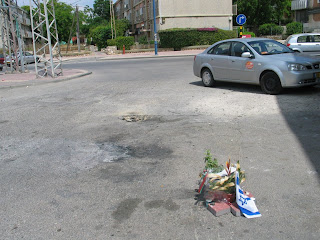
Noam took me to the center of the commercial area, where a Kassam killed a woman on a street ten days ago. A meter wide crater and a small bouquet of flowers mark the spot; shrapnel gouges can be seen on the buildings on both sides of the street. Many of the businesses are shuttered. We bought felafel from a man named "Prosper," who stated that some looting had taken place. He also remarked how Kassam payloads have become more explosive and damaging over time. His block has suffered several Kassam hits over the years. Noam shows me a row of stores that have been rebuilt. In between the shops are walls that extend a bit into the sidewalk, making the stores look like large cubicles. The compartmentalized design is intended to minimize the shrapnel spread at the point of impact.
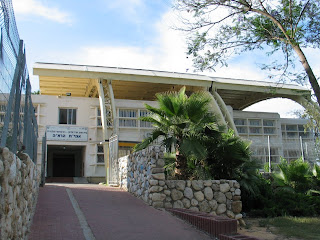
Noam guided me past several schools. According to his investigations, none of the schools are completely fortified against rocket attacks. There are however some very peculiar measures taken to at least partially protect the schoolchildren. One school has part of its gabled roof covered in an additional layer of latticed steel. Another has the entire building shaded by a sloping cover whose design reminded me of the some post-apocalyptic sci-fi movies.
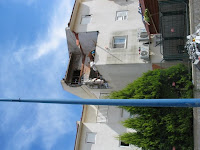
We drove past a house where a Kassam had slammed into a third story corner balcony and torn a gaping hole in a side wall. A crack ran from the newly ventilated adjoining bedroom to the opposite side of the house. Noam informed me that a commanding officer of the nearby United Nations peacekeeping force likens Kassams to "firecrackers."
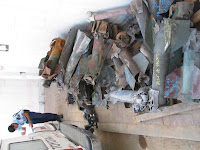
Next, we visited Sderot's police station, where the mangled remains of Kassams are stored in the rear parking lot. Over the past two weeks, 250 deployed missiles have found their way to the scrap heap. You can tell some of the older Kassams by the rust coating the fuselage. All are marked with phosphorescent chalk indicating the date and neighborhood of impact. Some have messages written in Hebrew from their manufacturers. "Al-Quds," Arabic for Jerusalem, is written on one. The fuselage tubes are fashioned from the poles of street signs. The Palestinian Authority apparently views the manufacture of anti-personnel weaponry as a function of civil infrastructure. Before we left, Noam and I tried to find the remains of the rocket that had killed Oshri Oz the day before.
Throughout the afternoon, as we drove through neighborhood after neighborhood, I saw teenagers walking in pairs. Some of the girls dressed in long skirts and sleeves, some in jeans and tank tops. Some of the boys wore kippot, some did not. All were carrying annotated street maps. These were the volunteers of "Lev Echad," Hebrew for "One Heart," a group that has tried to ease the humanitarian fallout of various recent tribulations in Israel. They helped the residents of Kiryat Shmona during rocket barrages last spring and summer. They helped the evicted residents of Gush Katif two years ago. After I finished looking at the spent Kassams at the police station, I visited the offices of Lev Echad. Some volunteers allowed me to take their pictures. Most did not, on instructions from the organizers, who say that they do not yet want to make publicity an issue for the volunteers to deal with.
Lev Echad volunteers were checking homes throughout Sderot for people who needed special help; mothers with young children, families handicapped dependents, elderly or handicapped persons who needed someone to shop for food, otherwise healthy people who succumbed to hysteria and the unrelenting emotional trauma of sirens and explosions. Every evening, Lev Echad stages a parade with flagbearers marching through Sderot, proud, optimistic, defiant of the savagery emanating from the border four kilometers southwest.
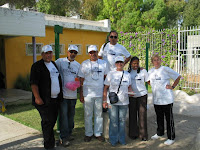
In the office courtyard, I noticed a group of volunteers old enough to be the parents of the teenagers and post-army twenty-somethings who made up the vast majority of Lev Echad. These were members of a community service organization from Beit She'an called, "Bonei Kehilah," Hebrew for "Community Builders."
I decided to put off my return trip north for a couple of hours to help with Lev Echad's efforts to follow up on individuals and families who had requested help. I was paired with twenty year-old Gilad, who was spending two days, out of his weeklong army furlough from army service, volunteering in Sderot. Meeting Gilad reminded me that it is individuals, not committees, who move the earth. We visited families, who were happy to have Lev Echad volunteers ask about them.
Gilad dropped me off at my car shortly after seven in the evening and I left Sderot shortly before Lev Echad's parade. Two Kassams landed in or near Sderot an hour or so after I left. Not far north of Sderot, I passed the hastily constructed housing project for evicted ex-Gush Katif residents in Nitzanim. I thought of the insult of added to the injury of these families. These Israeli patriots had lived for decades, much of the time in peace with their Arab neighbors, cultivating the land with citrus and vegetable crops of the highest quality. They were forcibly uprooted in order to let the Palestinians prove that they could govern Gaza peacefully. Now, they live within earshot of the missiles falling so close by. They know that Hamas and Al-Aqsa brigades are using the land in and around Gush Katif, their former homes, to stage deadly rocket attacks.
Why did I go down to Sderot and what does it have to do with Direct Representation? I needed to see what was real. The same bubble of self-delusion that lets many of us believe that Israel's democracy is sound also lulls us into thinking that Sderot is someone else's problem. If we do not act, speak out, or even bear witness as individuals, then we, as a society, will achieve and fix nothing. Direct Representation for Israel proposes the selection of our leaders and representatives as individuals; individuals chosen by the public because they are of the public and will work for the public. Individuals whose sense of moral clarity would not allow Sderot to suffer under Kassams for one month, let alone seven years. I found hope and moral clarity in some very special individuals in Sderot. People like Gilad and the other Lev Echad volunteers, who won't let citizens in Sderot suffer neglect. People like Noam Bedein, who won't let the world ignore Sderot. I spoke one-to-one to some about the need to assert individual responsibility as a political foundation, to institutionalize this in the way we choose our representatives and leader. For the most part, I found a receptive audience.
You can contact Lev Echad at 054-7587462/3.
 Last Monday, I made the trip from Zichron Yaakov, officially the "north" of the country, in a little under two hours. Towards the end of the drive, right before turning east on route 34, I saw the zeppelin-shaped reconnaissance balloon hovering over the southern edge of the city of Ashkelon. The balloon carries a sophisticated array of cameras and sensory equipment. Looking at it swaying in the wind, it seemed simultaneously ominous and flimsy, a ridiculous-looking, blow-up sentry that is an integral part of what protects us.
I arrived shortly after one in the afternoon. Few cars were in transit on the town's streets. I needed directions to get to the office of Noam Bedein, who runs the Sderot Media Center, which provides foreign journalists with background information and news about the continuous assault on Sderot. After spending ten minutes mentally reviewing the internet-sourced road directions, I parked and walked up the street looking for a local to guide me. After a few moments, I flagged a passing car. Before answering my requsst for directions, the driver briefed me on what to do if and when a "Tzeva Adom," a "red alert," sounded. I asked when the last one had sounded and he looked at me incredulously. Ten minutes earlier, just as I had entered the town limits. I made a mental note to keep the car stereo turned low or off. The announcement of a tzeva adom signals an imminent Kassam explosion, within 20 seconds. I later learned that most Kassams are launched in the morning hours between six and nine, and then at twilight, between seven and ten in the evening. This is done to coincide with Israel's broadcast television news cycle.
Kassam rockets are unpredictable, lethal projectiles capable of travelling up to 10km, around 6 miles. They can carry up to 10kg (22 lb.) of explosive payload. A major portion of this payload is devastating anti-personnel shrapnel: nails, bolts, and other packed bits of sharp metal intended to pierce skin, muscle, bone, and vital organs. These are not weapons intended to damage property or infrastructure; they are meant to injure, kill, and maim civilians. Kassams are meant to terrorize and after seven years of almost daily bombardment, many people in Sderot are indeed terrorized. Children are afraid to go to school and adults fear going outside to go to work.
Israeli defense officials categorize Kassams as "more a psychological rather than physical threat." Though Kassams alone will not physically harm the great majority of citizens in Sderot, their capacity for physical devastation and death is not subject to debate. At least eleven Israelis have lost their lives to Kassam rockets.
What is debatable is whether Israel's artificially-proportionally elected government is performing its mandate of responsibility for safeguarding Israel's citizens. The government of Ehud Olmert has promised a firm response to the Kassams, however even after the latest deaths most talk is of reinforcing structures in Sderot. Mayor Eli Moyal is quick to point out that injuries and deaths from Kassams occur outside. Moyal and his constituents want their national government to eliminate the threat of Kassams period. This means stopping the terrorists who launch the rockets. Unfortunately, there is no way of stopping the terrorists without insulting the politically correct sensibilities of Ehud Olmert's coalition partners, without contradicting the government's commitment to "disengagement."
I arrived at the Sderot Media Center, located at 12 Rakefet Street, nestled in a Dutch style subdivision of private houses. The enterprise was established eight months ago by Noam Bedein, a 24 year-old Ben-Gurion University student who hasn't been to classes much lately, thanks to his work in Sderot and the university student union strike. After serving in the IDF on the Lebanese border, Noam spent a year backpacking Asia. A budding photographer, Noam's prints of bamboo Thai countryside, snowcapped Tibetan peaks, Buddhist monks walking with tigers, and Sderot adorn his living room. If there is a thread that connects them, perhaps it's the beauty and savagery that exist in the real world, beyond the margins of our collective attention. In the near future, he will exhibit photographs and drawings on a more immediate subject, the terror and fear etched in the faces of the citizens of Sderot. Noam and his coworkers try to keep attention riveted on Sderot and provide essential details to help describe what, almost anywhere else, would be an unthinkable situation. An otherwise peaceful town absorbs daily rocket attacks from a clearly identified neighboring territory. The attacks are sanctioned by the neighboring local government, while the sovereign government of this peaceful town refrains from decisive response.

Noam updated me on the two red alerts in Sderot and the nine other Kassams, launched from residential areas in Gaza, that landed elsewhere in Israel's Western Negev that morning. Then Noam guided me on a Kassam-centered tour of Sderot. Our first stop was a home that took a direct hit last Saturday night. A rocket punched a hole in a wall at ground level and peppered shrapnel across a second floor bedroom wall, destroying the room's window. This is typical of Kassams, which usually diperse shrapnel in a reverse umbrella pattern. Fortunately, the twelve year old who normally sleeps in the room was elsewhere in the house at the time of impact.
Shula and David, whose front door walkway was covered in shattered glass, bits of masonry, and other debris, warmly welcomed Noam and me into their home. On our heels, a busload of foreign journalists were shepherded inside by Aryeh Green, director of MediaCentral, a journalist liaison service business in Jerusalem. Shula displayed shrapnel and bits of the rocket tube that remained after the police and army personnel removed most of the rocket's mass. Shula mentioned that neighbors up the street were hit earlier in the month. According to Noam, just about every neighborhood has been hit, sometimes causing property damage and sometimes ripping up the street. Structural repairs are made almost immediately.
After about twenty minutes, a car arrived to take Shula, David, and their sons to a hotel until the structural damage is repaired. Shula and David did not want to leave Sderot, unlike the 65% of Sderot residents who, according to Noam Bedein, have accepted offers at one time or another to leave the town for a short respite. At this point, some estimate that roughtly 20% of Sderot's residents are staying elsewhere.

Noam took me to the center of the commercial area, where a Kassam killed a woman on a street ten days ago. A meter wide crater and a small bouquet of flowers mark the spot; shrapnel gouges can be seen on the buildings on both sides of the street. Many of the businesses are shuttered. We bought felafel from a man named "Prosper," who stated that some looting had taken place. He also remarked how Kassam payloads have become more explosive and damaging over time. His block has suffered several Kassam hits over the years. Noam shows me a row of stores that have been rebuilt. In between the shops are walls that extend a bit into the sidewalk, making the stores look like large cubicles. The compartmentalized design is intended to minimize the shrapnel spread at the point of impact.

Noam guided me past several schools. According to his investigations, none of the schools are completely fortified against rocket attacks. There are however some very peculiar measures taken to at least partially protect the schoolchildren. One school has part of its gabled roof covered in an additional layer of latticed steel. Another has the entire building shaded by a sloping cover whose design reminded me of the some post-apocalyptic sci-fi movies.

We drove past a house where a Kassam had slammed into a third story corner balcony and torn a gaping hole in a side wall. A crack ran from the newly ventilated adjoining bedroom to the opposite side of the house. Noam informed me that a commanding officer of the nearby United Nations peacekeeping force likens Kassams to "firecrackers."

Next, we visited Sderot's police station, where the mangled remains of Kassams are stored in the rear parking lot. Over the past two weeks, 250 deployed missiles have found their way to the scrap heap. You can tell some of the older Kassams by the rust coating the fuselage. All are marked with phosphorescent chalk indicating the date and neighborhood of impact. Some have messages written in Hebrew from their manufacturers. "Al-Quds," Arabic for Jerusalem, is written on one. The fuselage tubes are fashioned from the poles of street signs. The Palestinian Authority apparently views the manufacture of anti-personnel weaponry as a function of civil infrastructure. Before we left, Noam and I tried to find the remains of the rocket that had killed Oshri Oz the day before.
Throughout the afternoon, as we drove through neighborhood after neighborhood, I saw teenagers walking in pairs. Some of the girls dressed in long skirts and sleeves, some in jeans and tank tops. Some of the boys wore kippot, some did not. All were carrying annotated street maps. These were the volunteers of "Lev Echad," Hebrew for "One Heart," a group that has tried to ease the humanitarian fallout of various recent tribulations in Israel. They helped the residents of Kiryat Shmona during rocket barrages last spring and summer. They helped the evicted residents of Gush Katif two years ago. After I finished looking at the spent Kassams at the police station, I visited the offices of Lev Echad. Some volunteers allowed me to take their pictures. Most did not, on instructions from the organizers, who say that they do not yet want to make publicity an issue for the volunteers to deal with.
Lev Echad volunteers were checking homes throughout Sderot for people who needed special help; mothers with young children, families handicapped dependents, elderly or handicapped persons who needed someone to shop for food, otherwise healthy people who succumbed to hysteria and the unrelenting emotional trauma of sirens and explosions. Every evening, Lev Echad stages a parade with flagbearers marching through Sderot, proud, optimistic, defiant of the savagery emanating from the border four kilometers southwest.

In the office courtyard, I noticed a group of volunteers old enough to be the parents of the teenagers and post-army twenty-somethings who made up the vast majority of Lev Echad. These were members of a community service organization from Beit She'an called, "Bonei Kehilah," Hebrew for "Community Builders."
I decided to put off my return trip north for a couple of hours to help with Lev Echad's efforts to follow up on individuals and families who had requested help. I was paired with twenty year-old Gilad, who was spending two days, out of his weeklong army furlough from army service, volunteering in Sderot. Meeting Gilad reminded me that it is individuals, not committees, who move the earth. We visited families, who were happy to have Lev Echad volunteers ask about them.
Gilad dropped me off at my car shortly after seven in the evening and I left Sderot shortly before Lev Echad's parade. Two Kassams landed in or near Sderot an hour or so after I left. Not far north of Sderot, I passed the hastily constructed housing project for evicted ex-Gush Katif residents in Nitzanim. I thought of the insult of added to the injury of these families. These Israeli patriots had lived for decades, much of the time in peace with their Arab neighbors, cultivating the land with citrus and vegetable crops of the highest quality. They were forcibly uprooted in order to let the Palestinians prove that they could govern Gaza peacefully. Now, they live within earshot of the missiles falling so close by. They know that Hamas and Al-Aqsa brigades are using the land in and around Gush Katif, their former homes, to stage deadly rocket attacks.
Why did I go down to Sderot and what does it have to do with Direct Representation? I needed to see what was real. The same bubble of self-delusion that lets many of us believe that Israel's democracy is sound also lulls us into thinking that Sderot is someone else's problem. If we do not act, speak out, or even bear witness as individuals, then we, as a society, will achieve and fix nothing. Direct Representation for Israel proposes the selection of our leaders and representatives as individuals; individuals chosen by the public because they are of the public and will work for the public. Individuals whose sense of moral clarity would not allow Sderot to suffer under Kassams for one month, let alone seven years. I found hope and moral clarity in some very special individuals in Sderot. People like Gilad and the other Lev Echad volunteers, who won't let citizens in Sderot suffer neglect. People like Noam Bedein, who won't let the world ignore Sderot. I spoke one-to-one to some about the need to assert individual responsibility as a political foundation, to institutionalize this in the way we choose our representatives and leader. For the most part, I found a receptive audience.
You can contact Lev Echad at 054-7587462/3.
Tuesday, April 17, 2007
How Difficult Can it Be?
As the Hebrew saying goes, "all beginnings are difficult." This rings true with nascent national movements, especially movements aspiring to real change in Israel. For months, we've been planning to form a recognized amutah (non-profit organization) with tax-exempt status, a step that would enable us to operate with tax exempt cash flow and for donors to receive tax deductible credit. This has not been a trivial undertaking and here's why.
In a 1990 Israeli legal precedent, an organization called "Constitution for Israel" failed to attain tax-exempt non-profit status from the Ministry of the Finance. According to Israeli tax law, tax exempt status can be conferred on four types of organizations: local municipalities, Mifal HaPayis (national lottery), retirement investment funds, and "public institutions." "Public institutions" are dedicated solely to "public purposes," and "public purposes" are defined by tax law as those related to "religion, culture, education, science, health, nourishment, sport, and other causes approved by the finance minister as public purposes."
Constitution for Israel sued the Finance Ministry, however the Supreme Court ruled in support of the then finance minister. "Constitution for Israel," the court opined, was not an institution with "only" cultural and/or educational purposes, not an organization "whose assets and income were used only for the attainment of public goals." According to the court, "Constitution for Israel" also wanted to influence legislation promoting a written constitution for the state of Israel. In other words, Constitution for Israel's public purposes became impure because the political realm was engaged in the service of those same purposes.
The Aharon Barak Supreme Court also rejected the argument that the finance minister was acting with any sort of political bias. No political bias? Many non-profit, public-minded institutions extend their mandates to influence political outcomes, which in turn serve the values of these organizations. The Israel Cancer Society has rightly lobbied and influenced legislation when it comes to tobacco and smoking restrictions. Religious organizations, including yeshivot, become involved with political initiatives when policy affects religious life. Constitution for Israel, however, sought to promote a process that would more clearly define the court's authority and its power in relation to other branches of government. Indeed, the selective denial of tax exempt status to organizations with public purposes could be viewed as a prime example of self-serving political bias. It exemplifies why our political system is a national embarrassment.
Practically speaking, most non-government non-profit organizations require tax-deductible status in order to recruit funding. The Israeli Supreme Court has effectively limited citizens who form the public from choosing, with their wallets, what they think is important for the public. The continued influence of that precedent underscores the gaping absence of public service norms; applied values which our organization seeks to instate. It also indicates the depth of the challenge that we must take on.
We are being advised by legal and accounting professionals to navigate the application processes with the non-profit registrar and the Ministry of Finance. This is a difficult time for us, but we are moving forward. The educational, cultural designation is, in fact, quite appropriate to our organization's mandate and goals. We have maintained, all along, that our goal is to revitalize a culture of citizen participation and empowerment as a bottom-up, grass roots initiative; that the route to real change runs via the Israeli public.
We will meet the challenges ahead of us and continue to organize whatever the immediate bureaucratic outcomes.
In a 1990 Israeli legal precedent, an organization called "Constitution for Israel" failed to attain tax-exempt non-profit status from the Ministry of the Finance. According to Israeli tax law, tax exempt status can be conferred on four types of organizations: local municipalities, Mifal HaPayis (national lottery), retirement investment funds, and "public institutions." "Public institutions" are dedicated solely to "public purposes," and "public purposes" are defined by tax law as those related to "religion, culture, education, science, health, nourishment, sport, and other causes approved by the finance minister as public purposes."
Constitution for Israel sued the Finance Ministry, however the Supreme Court ruled in support of the then finance minister. "Constitution for Israel," the court opined, was not an institution with "only" cultural and/or educational purposes, not an organization "whose assets and income were used only for the attainment of public goals." According to the court, "Constitution for Israel" also wanted to influence legislation promoting a written constitution for the state of Israel. In other words, Constitution for Israel's public purposes became impure because the political realm was engaged in the service of those same purposes.
The Aharon Barak Supreme Court also rejected the argument that the finance minister was acting with any sort of political bias. No political bias? Many non-profit, public-minded institutions extend their mandates to influence political outcomes, which in turn serve the values of these organizations. The Israel Cancer Society has rightly lobbied and influenced legislation when it comes to tobacco and smoking restrictions. Religious organizations, including yeshivot, become involved with political initiatives when policy affects religious life. Constitution for Israel, however, sought to promote a process that would more clearly define the court's authority and its power in relation to other branches of government. Indeed, the selective denial of tax exempt status to organizations with public purposes could be viewed as a prime example of self-serving political bias. It exemplifies why our political system is a national embarrassment.
Practically speaking, most non-government non-profit organizations require tax-deductible status in order to recruit funding. The Israeli Supreme Court has effectively limited citizens who form the public from choosing, with their wallets, what they think is important for the public. The continued influence of that precedent underscores the gaping absence of public service norms; applied values which our organization seeks to instate. It also indicates the depth of the challenge that we must take on.
We are being advised by legal and accounting professionals to navigate the application processes with the non-profit registrar and the Ministry of Finance. This is a difficult time for us, but we are moving forward. The educational, cultural designation is, in fact, quite appropriate to our organization's mandate and goals. We have maintained, all along, that our goal is to revitalize a culture of citizen participation and empowerment as a bottom-up, grass roots initiative; that the route to real change runs via the Israeli public.
We will meet the challenges ahead of us and continue to organize whatever the immediate bureaucratic outcomes.
Wednesday, January 31, 2007
How our system helps our enemies
In today's Jerusalem Post, you can find a prime example of why those trying to destroy Israel from within favor the current proportional system over a majoritarian one.
In "Dismantle Israel's tyranny of the majority
In "Dismantle Israel's tyranny of the majority
Sunday, December 24, 2006
Israel's Fear Of Its Majority
Today saw the third meeting of the Knesset's constitution and law committee. The topic of defining Israel's Jewish democracy was continued. It looks as if the committee will vote to include some mention of Israel's Arab minority and possibly a characterization of Israel as a parliamentary democracy. I would not be surprised if "proportionalism" will also be proposed. These specifications would be very detrimental to the principles of public service to a citizens' constituency based on individual rights.
The following is a draft version of an opinion piece I'll be sending out soon.
Israel's Fear of its Majority
“The people have spoken,” reads a type of bumper sticker that you can find on many Israeli cars, applied to a wide variety of political stands. “The majority wants...,” is another ubiquitous refrain appended with many, sometimes contradictory, claims. Political PR efforts, supporting various initiatives and campaigns, produce such slogans to resonate with a democratic principle of majority supposedly shared by Israel's mainstream public.
In practice, Israel's political establishment rarely makes an effort to satisfy the will of any popular majority and, except for limited survey samplings by political interests, rarely polls its public. When Israelis go to the polls during elections, they don't have the final word regarding specifically who will fill the seats in their legislature. In Israel's proportional system, that privilege is left to the party central committees, who get a number of seats in proportion to their share of the popular, nationwide vote. So, there is no direct, personal representation between sitting legislators and any body of citizen constituents.
The political philosophy behind Israel's system election and its government decision-making prevents the formation of an Israeli popular majority that will dictate a national direction. Since the founding of the state, no election has seen a single party receiving a popular majority of votes. Rather than vote for a person to act as a representative and public servant of a constituency, Israelis vote for a party on the basis of the party philosophy. Benefits of this system have been dubious; setbacks include nothing less than the disintegration of Israel's national identity and its collective will. Looking forward to the future, the political and social consequences may turn out to be existentially catastrophic.
The system of post-election coalition bargaining, part and parcel of our parliamentary system, effectively removes almost any influence a popular majority might have over policymaking in the executive part of the government. The party tapped to form the government will do almost anything, including reverse its pre-election platform policy if necessary, to satisfy the minimum number of coalition partners. When the promises are empty and citizens cannot hold their representatives individually to account, citizen involvement drops; public dialogue and debate deteriorate to mere slogans and eventually disappear.
The factional system generated through proportional elections produces a weak sense of public cohesion. This, in turn, produces either weak leaders who cater to strong narrow interests or despotic leaders who act with impunity and little respect for public interests or sentiment. One case in point is Ehud Olmert, perhaps the weakest prime minister in Israel's history, who stated in an interview before Rosh Hashanah, “A prime minister has to run a country. He doesn't have to have an agenda.” An example of despotism can be seen in Ariel Sharon's 2005 rape of Israel's political norms, enabled by the weak separation between the legislature and the executive branch, a weakness facilitated by parliamentary design. It is also questionable whether this system benefits minorities over the long term, given the capricious rotation of coalition partners that occurs when it suits the individuals heading a coalition government.
In contrast, majoritarian or “direct” elections, in which candidates compete personally for single seats in geographically distributed electoral districts, encourage public debate and the consolidation of diverse interests behind fewer candidates for public office. When only one will be elected, the diverse interests in a constituency do their best to find common cause with others in order to gain influence with a popular candidate. Minority interests find political “homes” within larger camps as long as there are not contradictions with the interests or values of the larger party. In this way, over the course of majoritarian elections, popular majorities organically take form within heterogeneous populations. In turn, national identities take shape and gather strength through a heterogeneous unity. Furthermore, collective bargaining among interests take place before the election, in stark contrast to the proportional, parliamentary system. As a result, citizens can make more powerful, more dependable choices.
In such systems, political parties do their best to engage public participation beyond the vote itself. Promises made before an election are more credible because winning candidates are personally accountable to their citizens and generally plan to run for more than a single term. A line of empowerment from constituency to representative exists in parallel to a line of accountability from representative to constituency. When citizens realize they really have the influence to choose their representatives, they have long memories of their representatives' promises and performance.
So, why does Israel maintain a system of politics that prevents the formation of a popular majority? The answer itself is very, very undemocratic. Put simply, the system is designed to lock in the “status quo,” the assumed balance of power distributed among the leaders of political factions. This reverence of the status quo is most readily apparent by the lack of public debate and dialogue running up to national elections. Most of Israel's political and academic elite fear a popular majority because it could shatter age old power sharing agreements between leaders of several different communities. For this reason, the power elites oppose changes to political proportionalism and parliamentarism.
The reverence of the status quo presumes that Israel's inter-community struggles are best avoided through institutionalized factional divisions. According to this logic, political and demographic separations between ethnic communities within a country prevent friction. According to this logic, diverse ethnic communities could never find sufficient common ground to live within a single public, subject to a mainstream unifying political culture. This principle, which has been applied since the founding of the state, is erroneous because a democracy cannot long survive with separate standards for different communities. It is dangerous because it actually stymies a national consensus to form in an enlightened public while it hobbles a nation's ability to adapt to its own environmental changes.
Consider the converse principle. When the significant unit of political entitlement is the individual citizen, when ethnic groups are not institutionalized to form official government entities, there is a greater chance of preventing struggles between groups and of individuals from diverse communities finding common cause. This does not deny the existence of minority communities; it signifies that individual citizens, through their directly elected representatives, will influence how the government relates to these communities. The factions committed to living under the principles of Jewish democracy, including moderate Haredim, must accept this as the only way a Jewish national resolve can survive. Factions committed to the eradication of a Jewish democracy, including anti-Zionist and radical factions, will be marginalized as they become politically non-viable in the mainstream.
Israel's near term future is filled with difficult choices. We face challenges of a growing population and growing infrastructure needs in a land with limited resources. We face numerous challenges in the global economy. We face powerful foes dedicated to our eradication. We face the dilemma of whether to make risky concessions or to defy international pressure to serve national interests. In light of these real challenges, our country cannot survive without public confidence in its government and united commitment to its national well-being. To our detriment, however, we are politically ill-equipped to face this reality. There are quantitative and qualitative indicators showing that our national will and national cohesion are deteriorating to a dangerously low level of commitment. Israel's national will, based on the shared identity of its citizens, stands a chance of healing only when the converse of the status quo principle, the majoritarian principle, is applied. Israel must make the momentous decision to slaughter the sacred cow of the status quo and serve the sovereignty of an emergent popular majority.
The following is a draft version of an opinion piece I'll be sending out soon.
Israel's Fear of its Majority
“The people have spoken,” reads a type of bumper sticker that you can find on many Israeli cars, applied to a wide variety of political stands. “The majority wants...,” is another ubiquitous refrain appended with many, sometimes contradictory, claims. Political PR efforts, supporting various initiatives and campaigns, produce such slogans to resonate with a democratic principle of majority supposedly shared by Israel's mainstream public.
In practice, Israel's political establishment rarely makes an effort to satisfy the will of any popular majority and, except for limited survey samplings by political interests, rarely polls its public. When Israelis go to the polls during elections, they don't have the final word regarding specifically who will fill the seats in their legislature. In Israel's proportional system, that privilege is left to the party central committees, who get a number of seats in proportion to their share of the popular, nationwide vote. So, there is no direct, personal representation between sitting legislators and any body of citizen constituents.
The political philosophy behind Israel's system election and its government decision-making prevents the formation of an Israeli popular majority that will dictate a national direction. Since the founding of the state, no election has seen a single party receiving a popular majority of votes. Rather than vote for a person to act as a representative and public servant of a constituency, Israelis vote for a party on the basis of the party philosophy. Benefits of this system have been dubious; setbacks include nothing less than the disintegration of Israel's national identity and its collective will. Looking forward to the future, the political and social consequences may turn out to be existentially catastrophic.
The system of post-election coalition bargaining, part and parcel of our parliamentary system, effectively removes almost any influence a popular majority might have over policymaking in the executive part of the government. The party tapped to form the government will do almost anything, including reverse its pre-election platform policy if necessary, to satisfy the minimum number of coalition partners. When the promises are empty and citizens cannot hold their representatives individually to account, citizen involvement drops; public dialogue and debate deteriorate to mere slogans and eventually disappear.
The factional system generated through proportional elections produces a weak sense of public cohesion. This, in turn, produces either weak leaders who cater to strong narrow interests or despotic leaders who act with impunity and little respect for public interests or sentiment. One case in point is Ehud Olmert, perhaps the weakest prime minister in Israel's history, who stated in an interview before Rosh Hashanah, “A prime minister has to run a country. He doesn't have to have an agenda.” An example of despotism can be seen in Ariel Sharon's 2005 rape of Israel's political norms, enabled by the weak separation between the legislature and the executive branch, a weakness facilitated by parliamentary design. It is also questionable whether this system benefits minorities over the long term, given the capricious rotation of coalition partners that occurs when it suits the individuals heading a coalition government.
In contrast, majoritarian or “direct” elections, in which candidates compete personally for single seats in geographically distributed electoral districts, encourage public debate and the consolidation of diverse interests behind fewer candidates for public office. When only one will be elected, the diverse interests in a constituency do their best to find common cause with others in order to gain influence with a popular candidate. Minority interests find political “homes” within larger camps as long as there are not contradictions with the interests or values of the larger party. In this way, over the course of majoritarian elections, popular majorities organically take form within heterogeneous populations. In turn, national identities take shape and gather strength through a heterogeneous unity. Furthermore, collective bargaining among interests take place before the election, in stark contrast to the proportional, parliamentary system. As a result, citizens can make more powerful, more dependable choices.
In such systems, political parties do their best to engage public participation beyond the vote itself. Promises made before an election are more credible because winning candidates are personally accountable to their citizens and generally plan to run for more than a single term. A line of empowerment from constituency to representative exists in parallel to a line of accountability from representative to constituency. When citizens realize they really have the influence to choose their representatives, they have long memories of their representatives' promises and performance.
So, why does Israel maintain a system of politics that prevents the formation of a popular majority? The answer itself is very, very undemocratic. Put simply, the system is designed to lock in the “status quo,” the assumed balance of power distributed among the leaders of political factions. This reverence of the status quo is most readily apparent by the lack of public debate and dialogue running up to national elections. Most of Israel's political and academic elite fear a popular majority because it could shatter age old power sharing agreements between leaders of several different communities. For this reason, the power elites oppose changes to political proportionalism and parliamentarism.
The reverence of the status quo presumes that Israel's inter-community struggles are best avoided through institutionalized factional divisions. According to this logic, political and demographic separations between ethnic communities within a country prevent friction. According to this logic, diverse ethnic communities could never find sufficient common ground to live within a single public, subject to a mainstream unifying political culture. This principle, which has been applied since the founding of the state, is erroneous because a democracy cannot long survive with separate standards for different communities. It is dangerous because it actually stymies a national consensus to form in an enlightened public while it hobbles a nation's ability to adapt to its own environmental changes.
Consider the converse principle. When the significant unit of political entitlement is the individual citizen, when ethnic groups are not institutionalized to form official government entities, there is a greater chance of preventing struggles between groups and of individuals from diverse communities finding common cause. This does not deny the existence of minority communities; it signifies that individual citizens, through their directly elected representatives, will influence how the government relates to these communities. The factions committed to living under the principles of Jewish democracy, including moderate Haredim, must accept this as the only way a Jewish national resolve can survive. Factions committed to the eradication of a Jewish democracy, including anti-Zionist and radical factions, will be marginalized as they become politically non-viable in the mainstream.
Israel's near term future is filled with difficult choices. We face challenges of a growing population and growing infrastructure needs in a land with limited resources. We face numerous challenges in the global economy. We face powerful foes dedicated to our eradication. We face the dilemma of whether to make risky concessions or to defy international pressure to serve national interests. In light of these real challenges, our country cannot survive without public confidence in its government and united commitment to its national well-being. To our detriment, however, we are politically ill-equipped to face this reality. There are quantitative and qualitative indicators showing that our national will and national cohesion are deteriorating to a dangerously low level of commitment. Israel's national will, based on the shared identity of its citizens, stands a chance of healing only when the converse of the status quo principle, the majoritarian principle, is applied. Israel must make the momentous decision to slaughter the sacred cow of the status quo and serve the sovereignty of an emergent popular majority.
Tuesday, December 12, 2006
Constitutional Committee 10 December 2006
Yesterday, the Knesset's Committee on Constitution, Law, and Justice met for the second time under the leadership of Menachem Ben-Sasson. This meeting concentrated on the issue of the interests and considerations of Israel's Arab citizens.
Present: Menachem Ben-Sasson (Chair-Kadima), Colette Avital (Labor), Haim Oron (Meretz), Aryeh Eldad (National Unity - NRP), Moshe Gafney (Torah Judaism), Amira Dotan (Kadima), Matan Vilnai (Labor), Nissim Zeev (Shas), Avraham Michaeli (Shas), Avraham Ravitz (Torah Judaism), Reuven Rivlin (Likud), and Otniel Schneller (Kadima).
The legal consultant described a proposed clause that explicitly mentioned that the group rights of minorities, especially the Arab minority, would be recognized. This, of course, is highly problematic. Firstly, from an civil rights perspective, such a clause is completely unnecessary. There will certainly be clauses protecting the individual rights of every Israeli citizen, regardless of sex, race, religion, or ethnicity, and this should be the last word on civil rights. The proposed clause is highly problematic because it explicitly and implicitly sanctions differential treatment of members of minority groups.
Explicitly acknowledging the rights of an Arab minority, as a community and not only as individual citizens, can be interpreted as a license for the Arab community to have a different legal code than non-Arabs. Indeed, this concept surfaced later in the session.
Elyakim Rubenstein, of the Herzliya Interdisciplinary Center presented his views that the constitution will honor the rights of the Arab minority.
A scholar on Arab Affairs, Michael Kariani, was invited to address the committee. He stated that he would speak from his own personal perspective. Kariani began by quoting the recently released Iraq Study Group report commissioned by President George W. Bush. The group, led by former Secretary of State James Baker III, whose anti-Israel biases are widely acknowledged, declared that the Arab-Israeli conflict is inextricably linked to Iraq and, by implication, to every other issue of instability in the Middle East. Bush has distanced himself from that and other highly problematic conclusions of the report. That Kariani would raise the report, as an introduction to his comment on the constitution, is a clear indication of the rhetorical ammunition he plans to use and to what purpose. Labeling the Arab-Israeli conflict the central cause of instability in the Middle East has been the excuse of dictators and anti-Semitic terror apologists for decades.
The meat of Kariani's address was a basic opposition to a constitution, especially one that declared Israel a Jewish and democratic state, unless there were clear safeguards and benefits for the Arab community. He called for continuing dialogue between the two communities. The clear message was that Israeli Arabs who feel like Kariani would continue and amplify their efforts to secure a special status as a "nation within a nation." The best we will be able to hope for is not a single heterogeneous, integrated Jewish/Muslim/Christian public, but a dual-national, sectarian arrangement.
Next up was Yisrael Harel, of the Institute for Zionist Strategy. Harel stressed the need to attain a "constitution of consensus" while a consensus exists. Harel doesn't realize that a consensus does not exist and will never exist; that the only hope for a constitution, and for a continued Zionist viability, is an appeal to a wide popular majority. Only by allowing a popular Zionist majority to form will Harel be able to help the country's political system withstand the challenges from both the narrow interests and the Arab, anti-Zionist minority.
Prof. Eli Reches, an Arab-affairs expert from Tel Aviv University, provided further perspective from the Arab community. Among his observations and conclusions:
The big surprise of the meeting was the pronouncement of Torah Judaism's Moshe Gafney. Gafney stated that his Haredi faction would welcome a constitution because it is the only way to stop the Supreme Court from legislating from the bench, almost always with a pronounced bias in favor of Arab and extreme left positions and against traditional, Orthodox Jewish religious positions. Gafney also qualified his support of a constitution with the caveat that it would have to be "thick" enough to ensure Haredi interests, i.e., the Haredi veto. This, of course, would be disastrous in that it would alienate most of mainstream Israel, in addition to being ethically unsound.
More than ever, I'm convinced that Israel faces systemic political challenges that could make it impossible for it to face its physical existential threats. Israel's lack of a popular majority weakens its posture in the face of an increasingly antagonistic Arab minority. Furthermore, the willingness of Israel's political elite (Meretz, Labor, Kadima) to officially accommodate Arab nationalism is tantamount to Zionist suicide.
Present: Menachem Ben-Sasson (Chair-Kadima), Colette Avital (Labor), Haim Oron (Meretz), Aryeh Eldad (National Unity - NRP), Moshe Gafney (Torah Judaism), Amira Dotan (Kadima), Matan Vilnai (Labor), Nissim Zeev (Shas), Avraham Michaeli (Shas), Avraham Ravitz (Torah Judaism), Reuven Rivlin (Likud), and Otniel Schneller (Kadima).
The legal consultant described a proposed clause that explicitly mentioned that the group rights of minorities, especially the Arab minority, would be recognized. This, of course, is highly problematic. Firstly, from an civil rights perspective, such a clause is completely unnecessary. There will certainly be clauses protecting the individual rights of every Israeli citizen, regardless of sex, race, religion, or ethnicity, and this should be the last word on civil rights. The proposed clause is highly problematic because it explicitly and implicitly sanctions differential treatment of members of minority groups.
Explicitly acknowledging the rights of an Arab minority, as a community and not only as individual citizens, can be interpreted as a license for the Arab community to have a different legal code than non-Arabs. Indeed, this concept surfaced later in the session.
Elyakim Rubenstein, of the Herzliya Interdisciplinary Center presented his views that the constitution will honor the rights of the Arab minority.
A scholar on Arab Affairs, Michael Kariani, was invited to address the committee. He stated that he would speak from his own personal perspective. Kariani began by quoting the recently released Iraq Study Group report commissioned by President George W. Bush. The group, led by former Secretary of State James Baker III, whose anti-Israel biases are widely acknowledged, declared that the Arab-Israeli conflict is inextricably linked to Iraq and, by implication, to every other issue of instability in the Middle East. Bush has distanced himself from that and other highly problematic conclusions of the report. That Kariani would raise the report, as an introduction to his comment on the constitution, is a clear indication of the rhetorical ammunition he plans to use and to what purpose. Labeling the Arab-Israeli conflict the central cause of instability in the Middle East has been the excuse of dictators and anti-Semitic terror apologists for decades.
The meat of Kariani's address was a basic opposition to a constitution, especially one that declared Israel a Jewish and democratic state, unless there were clear safeguards and benefits for the Arab community. He called for continuing dialogue between the two communities. The clear message was that Israeli Arabs who feel like Kariani would continue and amplify their efforts to secure a special status as a "nation within a nation." The best we will be able to hope for is not a single heterogeneous, integrated Jewish/Muslim/Christian public, but a dual-national, sectarian arrangement.
Next up was Yisrael Harel, of the Institute for Zionist Strategy. Harel stressed the need to attain a "constitution of consensus" while a consensus exists. Harel doesn't realize that a consensus does not exist and will never exist; that the only hope for a constitution, and for a continued Zionist viability, is an appeal to a wide popular majority. Only by allowing a popular Zionist majority to form will Harel be able to help the country's political system withstand the challenges from both the narrow interests and the Arab, anti-Zionist minority.
Prof. Eli Reches, an Arab-affairs expert from Tel Aviv University, provided further perspective from the Arab community. Among his observations and conclusions:
- Israeli Arabs are increasingly becoming involved with the Palestinian national movement.
- Israeli Arabs don't see themselves as part of a national solution.
- An amalgamation of all Arab subgroups.
- A separation of Israel's democratic and Jewish characteristics in the eyes of Israeli Arabs.
- An increased activation of Naqbah rhetoric.
- Israeli Arab view of Israel as a continuation of European colonialism.
The big surprise of the meeting was the pronouncement of Torah Judaism's Moshe Gafney. Gafney stated that his Haredi faction would welcome a constitution because it is the only way to stop the Supreme Court from legislating from the bench, almost always with a pronounced bias in favor of Arab and extreme left positions and against traditional, Orthodox Jewish religious positions. Gafney also qualified his support of a constitution with the caveat that it would have to be "thick" enough to ensure Haredi interests, i.e., the Haredi veto. This, of course, would be disastrous in that it would alienate most of mainstream Israel, in addition to being ethically unsound.
More than ever, I'm convinced that Israel faces systemic political challenges that could make it impossible for it to face its physical existential threats. Israel's lack of a popular majority weakens its posture in the face of an increasingly antagonistic Arab minority. Furthermore, the willingness of Israel's political elite (Meretz, Labor, Kadima) to officially accommodate Arab nationalism is tantamount to Zionist suicide.
Sunday, November 26, 2006
First Meeting of the Constitutional Committee
On Sunday morning, 26 November 2006, the inaugural meeting of the Constitution, Law, and Justice Committee was convened under the new leadership of MK Prof. Menachem Ben-Sasson (Kadima). This was roughly a month following the three-day information seminar (that I described in my last blog entry).
MKs present included Ben-Sasson, Moshe Gafney (Torah Judaism), Matan Vilnai (Labor), Nissim Zeev (Shas), Yitzhak Levy (National Union-NRP), Avraham Michaeli (Shas), Otniel Schneller (Kadima), Avraham Ravitz (Torah Judaism), and Reuven Rivlin (Likud).
Committee members (according to the Knesset web site) not present included Michael Eitan (Likud), Yitzhak Galant (Gil), Collette Avital (Labor), Azmi Bishara (National Democratic Assembly), Talab El-Sana (Arab Democratic Party-United Arab List), Zahava Gal'on (Meretz), Amira Dotan (Kadima), Danny Yatom (Labor), Limor Livnat (Likud), Danny Naveh (Likud), and Ophir Pines-Paz (Labor).
Not much actually occurred during this meeting. There were the expected opening remarks about the importance of the committee's work and some ground rules regarding decorum.
First, a draft proposal of the first chapter, under the heading "Democracy," defines Israel's democratic character as "parliamentary." This likely prejudices the outcome against a presidential system and therefore against a strong separation between legislative and exective branches.
Second, among the nine MKs present at this first meeting, four represented Haredi parties who are likely opposed to any significant changes towards either a presidential system, towards direct election of MKs, or towards majoritarian principles of government.
Third, at one point in the meeting, Moshe Gafney (Torah Judaism) openly stated that his party insisted on veto powers (presemably regarding specific categories of law) and that any changes at all would have to maintain that veto.
To sum up, the new Constitution and Law Committee does not seem very receptive to any significant changes to the current proportional, parliamentary system. The direction is towards some tweaks that still rely on the "goodwill" of officials still appointed by party central committees. As I've mentioned for quite some time, any real changes will have to come from immense popular pressure.
The Israeli body politic will reduce the undue influence of small, narrow interest parties when it accepts a majority system of elections and abandons the mischaracterized "proportional system." The only proportional constituency represented by the current system is the population of party dealmakers.
MKs present included Ben-Sasson, Moshe Gafney (Torah Judaism), Matan Vilnai (Labor), Nissim Zeev (Shas), Yitzhak Levy (National Union-NRP), Avraham Michaeli (Shas), Otniel Schneller (Kadima), Avraham Ravitz (Torah Judaism), and Reuven Rivlin (Likud).
Committee members (according to the Knesset web site) not present included Michael Eitan (Likud), Yitzhak Galant (Gil), Collette Avital (Labor), Azmi Bishara (National Democratic Assembly), Talab El-Sana (Arab Democratic Party-United Arab List), Zahava Gal'on (Meretz), Amira Dotan (Kadima), Danny Yatom (Labor), Limor Livnat (Likud), Danny Naveh (Likud), and Ophir Pines-Paz (Labor).
Not much actually occurred during this meeting. There were the expected opening remarks about the importance of the committee's work and some ground rules regarding decorum.
First, a draft proposal of the first chapter, under the heading "Democracy," defines Israel's democratic character as "parliamentary." This likely prejudices the outcome against a presidential system and therefore against a strong separation between legislative and exective branches.
Second, among the nine MKs present at this first meeting, four represented Haredi parties who are likely opposed to any significant changes towards either a presidential system, towards direct election of MKs, or towards majoritarian principles of government.
Third, at one point in the meeting, Moshe Gafney (Torah Judaism) openly stated that his party insisted on veto powers (presemably regarding specific categories of law) and that any changes at all would have to maintain that veto.
To sum up, the new Constitution and Law Committee does not seem very receptive to any significant changes to the current proportional, parliamentary system. The direction is towards some tweaks that still rely on the "goodwill" of officials still appointed by party central committees. As I've mentioned for quite some time, any real changes will have to come from immense popular pressure.
The Israeli body politic will reduce the undue influence of small, narrow interest parties when it accepts a majority system of elections and abandons the mischaracterized "proportional system." The only proportional constituency represented by the current system is the population of party dealmakers.
Wednesday, November 22, 2006
Olmert's Grand Plan
Ehud Olmert has discovered political religion. The man who instantly leapt from number 13 on the Likud list to lead Kadima when Sharon was stricken, the operator who ran on a platform of no substance, the pol who made millions on real estate deals while in public office, the hack who, along with Sharon, welched on Likud voters by making Gaza a "self-governing" terrorist stronghold, would like us to believe that he favors principled reform.
His suggestions? First, he'd like to make it difficult or impossible for the Knesset to challenge the legitimacy of the prime minister's office. He wants to set a minimum of 66 MKs to pass a no-confidence motion and a minimum of 73 to dissolve Knesset.
Second, he'd like to empower the prime minister to dissolve the Knesset without disbanding the prime minister's office.
Third, there are changes intended to separate the cabinet from the legislature and make it more responsible to the chief executive, i.e, the PM, and subject to the PM's policy decisions. The cabinet itself would be limited to 18 ministers, one-fourth of whom would be experts in their fields who did not run for Knesset. MKs appointed ministers would quit the Knesset, but could return if they left their ministerial post.
This is reform, right? The prime minister will be empowered to implement policy, right? But there is an overpowering stench to this initiative of Olmert's. It's the stench of doublespeak and exploitation; the stench of powerhungry manipulation and demagoguery. It is the ever-growing stench of counterfeit democracy and the abuse of the privileges of public service.
Yes, the executive branch should be redesigned to operate separately from the legislature. Israel would benefit greatly from a presidential system that treats the executive branch as a public service, corporate, professional entity. Yes, government ministers must not serve concurrently as MKs, as the present system harbors a terrible conflict of interests; ministers vote on their own budgets and influence their own oversight. Yes, government ministers should be professional experts in their fields.
It is also the case that separate branches should not easily control each other, or influence the selection of each other's members. In a proper, balanced presidential system, a chief executive should not be able to dictate who shall sit in the legislature and the legislature should not be able to dictate whom the chief executive should choose to serve as his ministerial counsel.
The key word here, the principle that Olmert is either ignoring or eschewing, is that of balance. More specifically, Olmert's proposal lacks a sufficient means of balancing the powers among the legislative, executive, and judicial branches. Olmert's suggestion that a chief executive should be able to dismiss or disband the legislature, the governmental body that most directly represents the public, is a grotesque mischaracterization of responsible presidential privilege.
If Ehud Olmert truly wants to stabilize the Israeli government and empower his executive office, presumably for the sake of efficiency, accountability, and service, then there is a simple and highly effective model that has been operating for over two hundred years. It is the American presidential system that incorporates strong checks and balances against abuses of power while allowing the chief executive to fulfill a mandate as chosen by a majority of voters in his direct election.
James Madison's brilliant prescriptive analysis of the balance of powers can be found in The Federalist Papers, which should be required reading of our lawmakers, pundits, and concerned citizens.
"It is ... evident, that none of them (i.e., governmental branches,) ought to possess, directly or indirectly, an overruling influence over the others, in the administration of their respective powers... the great security against a gradual concentration of the several powers in the same department, consists in giving to those who administer each department the necessary constitutional means and personal motives to resist encroachments of the others."
As Thomas Jefferson is quoted from that same document, "the powers of government should be so divided and balanced among several bodies of magistracy, as that no one could transcend their legal limits, without being effectually checked and restrained by the others... the legislative, executive, and judiciary departments should be separate and distinct, so that no person should exercise the powers of more than one of them at the same time."
So, Ehud, it makes sense that the legislature should respect the mandate of a chief executive in executing policy. What you'd better learn is that it's even more important that you keep your greedy hands off the sovereignty of the legislature in passing the laws and in checking the executive branch against abuses of power. If you should have the right to serve out a term as chief of the executive branch, then barring extreme circumstances so should every popularly elected legislator in the Knesset.
It is time for our political leaders to stop looking at failed, poorly applied European models, and look westward to a system that has never compromised on values of majority rule and individual political responsibility. Yes, we need a presidential system that allows strong leadership in executing policy; a system that rewards and validates that leadership when it excels. At the same time, we need a strong legislature, secure in its mandate to legislate the laws or our country with limited hindrance from the executive and legislative branches. The separation without balance that Olmert proposes would tip the balance of power in government heavily in favor of the executive. It is either through sheer ignorance of democratic political theory that he proposes it, or it is a self-serving power strategem worthy of dictators and soviet-style state tyranny.
In addition to a balanced presidential system that separates government branches, we need a system that helps its society form broad majorities of wide interests, complex enough that they may incorporate many categories of social minorities. This can't happen with a proportional system of electing legislative representatives. Proportionalism, after all, rewards divisiveness as smaller groups with narrow interests tip the balance of influence among larger players. The formation of a political social majority can only happen within a true majority system, in which a single representative is elected in each electoral district.
It is about time that Israel's pundits and talking heads stopped trying to perform plastic surgery to make an inefficient, divisive parliamentary system look and act like a presidential republic. We deserve and need the real thing.
His suggestions? First, he'd like to make it difficult or impossible for the Knesset to challenge the legitimacy of the prime minister's office. He wants to set a minimum of 66 MKs to pass a no-confidence motion and a minimum of 73 to dissolve Knesset.
Second, he'd like to empower the prime minister to dissolve the Knesset without disbanding the prime minister's office.
Third, there are changes intended to separate the cabinet from the legislature and make it more responsible to the chief executive, i.e, the PM, and subject to the PM's policy decisions. The cabinet itself would be limited to 18 ministers, one-fourth of whom would be experts in their fields who did not run for Knesset. MKs appointed ministers would quit the Knesset, but could return if they left their ministerial post.
This is reform, right? The prime minister will be empowered to implement policy, right? But there is an overpowering stench to this initiative of Olmert's. It's the stench of doublespeak and exploitation; the stench of powerhungry manipulation and demagoguery. It is the ever-growing stench of counterfeit democracy and the abuse of the privileges of public service.
Yes, the executive branch should be redesigned to operate separately from the legislature. Israel would benefit greatly from a presidential system that treats the executive branch as a public service, corporate, professional entity. Yes, government ministers must not serve concurrently as MKs, as the present system harbors a terrible conflict of interests; ministers vote on their own budgets and influence their own oversight. Yes, government ministers should be professional experts in their fields.
It is also the case that separate branches should not easily control each other, or influence the selection of each other's members. In a proper, balanced presidential system, a chief executive should not be able to dictate who shall sit in the legislature and the legislature should not be able to dictate whom the chief executive should choose to serve as his ministerial counsel.
The key word here, the principle that Olmert is either ignoring or eschewing, is that of balance. More specifically, Olmert's proposal lacks a sufficient means of balancing the powers among the legislative, executive, and judicial branches. Olmert's suggestion that a chief executive should be able to dismiss or disband the legislature, the governmental body that most directly represents the public, is a grotesque mischaracterization of responsible presidential privilege.
If Ehud Olmert truly wants to stabilize the Israeli government and empower his executive office, presumably for the sake of efficiency, accountability, and service, then there is a simple and highly effective model that has been operating for over two hundred years. It is the American presidential system that incorporates strong checks and balances against abuses of power while allowing the chief executive to fulfill a mandate as chosen by a majority of voters in his direct election.
James Madison's brilliant prescriptive analysis of the balance of powers can be found in The Federalist Papers, which should be required reading of our lawmakers, pundits, and concerned citizens.
"It is ... evident, that none of them (i.e., governmental branches,) ought to possess, directly or indirectly, an overruling influence over the others, in the administration of their respective powers... the great security against a gradual concentration of the several powers in the same department, consists in giving to those who administer each department the necessary constitutional means and personal motives to resist encroachments of the others."
As Thomas Jefferson is quoted from that same document, "the powers of government should be so divided and balanced among several bodies of magistracy, as that no one could transcend their legal limits, without being effectually checked and restrained by the others... the legislative, executive, and judiciary departments should be separate and distinct, so that no person should exercise the powers of more than one of them at the same time."
So, Ehud, it makes sense that the legislature should respect the mandate of a chief executive in executing policy. What you'd better learn is that it's even more important that you keep your greedy hands off the sovereignty of the legislature in passing the laws and in checking the executive branch against abuses of power. If you should have the right to serve out a term as chief of the executive branch, then barring extreme circumstances so should every popularly elected legislator in the Knesset.
It is time for our political leaders to stop looking at failed, poorly applied European models, and look westward to a system that has never compromised on values of majority rule and individual political responsibility. Yes, we need a presidential system that allows strong leadership in executing policy; a system that rewards and validates that leadership when it excels. At the same time, we need a strong legislature, secure in its mandate to legislate the laws or our country with limited hindrance from the executive and legislative branches. The separation without balance that Olmert proposes would tip the balance of power in government heavily in favor of the executive. It is either through sheer ignorance of democratic political theory that he proposes it, or it is a self-serving power strategem worthy of dictators and soviet-style state tyranny.
In addition to a balanced presidential system that separates government branches, we need a system that helps its society form broad majorities of wide interests, complex enough that they may incorporate many categories of social minorities. This can't happen with a proportional system of electing legislative representatives. Proportionalism, after all, rewards divisiveness as smaller groups with narrow interests tip the balance of influence among larger players. The formation of a political social majority can only happen within a true majority system, in which a single representative is elected in each electoral district.
It is about time that Israel's pundits and talking heads stopped trying to perform plastic surgery to make an inefficient, divisive parliamentary system look and act like a presidential republic. We deserve and need the real thing.
Monday, October 23, 2006
Having Words
Last Thursday, the Knesset committee on the constitution, chaird by Prof. Menachem Ben-Sasson, began a three-day conference, which continued today and will conclude on Tuesday. Today's afternoon session discussed forms of government.
Over the course of three hours, the newly cobbled Hebrew word for accountability, "achrayutiut" was evoked several times. Any student of Hebrew grammar and etymology can tell you that this is a nonsense word. The ut suffix suffix changes "achrai" (responsible) into "achrayut" (responsibility). The new word, "achrayut-i-ut" is the result of tacking on a second morphing ut suffix. The morphological English equivalent of achrayutiut would be something like "responsibility-ism" or "responsibility-ness," a far cry from "accountability."
Around the time achrayutiut was being accorded a stamp of approval by Israel's academic political elite (but not by its academic linguistic elite), another Hebrew equivalent for accountability was making a much smaller splash across the national palate. "davchanut" (note the single ut) morphed directly out of the Hebrew root for "account" or "report," "le-daveach."
The dominant acceptance of achrayutiut over davchanut by the political elite says a great deal about the elite's (lack of) readiness to address the issue of public accountability. The difference between these two expressions is the difference between responsibility to act in the best interests of some entity and the accountability that can include a public justification of one's deeds. Parents are responsible to their children, however they are not normally held accountable by their children. An employee, in contrast, is responsible to his employer and normally must account for his actions through reports or third party observations. achrayut applied in the political context conceptualizes the elected official as an empowered guardian of the public rather than an empowered public servant.
This distinction was completely lost on the academic panel.
This occurence reflects the broader inability of the Israeli political elite to consider anything but a proportional electoral system. Proportionalism removes individual accountability from the political equation by officially removing the individual significance of the politician from the public's choice. It treats its sectarian, partisan constituencies like adopted wards, focusing on serving the declared interests of the party membershp but feeling little need for individual MKs to justify their actions to any public at large. The linguistic preference does not bode well for any emergent system that will place individual accountability of MKs at the head of the national political agenda.
As I walked through the Knesset, I ran into Prof. Yitzhak Gal-Noor of the Hebrew University, one of the academic panelists, none of whom had anything positive to say about the presidential system. He commented that nothing about the American system of government is applicable to Israel. When I asked why, what was so different about Israel, for lack of any specific reason, he simply said, "Because we are more European."
This one statement has affirmed every assumption I have had regarding the political and cultural preferences of the influential elite in Israel. This elite seeks to emulate Europe, to be part of Europe, and so bends over backwards at its own existential peril to curry favor with Europe. Part of this fawning is apparently the avoidance of any conceptual association with the United States, despite the latter's status as Israel's closest, most supportive strategic ally. In the eyes of the Euro-centric academic elite, any footfall in the direction of American values is simply unacceptable on its face.
Israel, like the United States and unlike most European states, is a country of immigrants. Most Israeli immigrants have arrived within the last thirty years, from non-European countries. Both Israel and the United States are multicultural. How ironic that the Israeli elite seeks towards European political values when those values have classically failed to serve Jewish interests except for the briefest periods in history.
The given dominant paradigm of the Israeli elite assumes that without proportional representation, the fabric of Israeli society will unravel. It assumes that Israelis, whether Arab, Jewish, Haredi, Secular, Muslim, Christian, Ethiopian, Sabra, - whatever - are simply incapable of thinking as individuals or of electing officials as individuals. How incredibly and outrageously demeaning! How fitting with proportionalism's notion that the sub-collective, the party central committee, must be the individual's thinking proxy. Again, how consonant with political achrayutiut over political davchanut.
These academics refuse to see that when government is provides factions with quasi-official status, through proportional party representation, the walls of factionalism become ever stronger, as do the rewards of political separatism. When the individual is forced to choose a collective as a political mediator, rather than vote for an individual representative, public service based on individual responsibility and accessibility suffers. These academics deny the reality that every individual citizen is his own minority with his own unique set of needs, outlooks, and aspirations.
In my comments, I stated that conflicts of interest are inherent in every parliamentary system, a point Prof. Reuven Chazan flatly denied. Well, technically, there might be some arrangement in which a parliamentary system could effectively prevent legislators from situations in which they have to compromise their responsibility to the public. However, as long as the legislature is charged with protecting citizens against abuses of executive power, the executive and legislative branches must be hermetically separated. In every parliamentary system that I know of, there is either no separation at all, or there are paper-thin pseudo-separations. Chazan supports the Norwegian system, in which legislators who become ministers give up their legislative positions and the seat is filled by that legislator's party's choice. This is not a conflict of interests?
Over the course of three hours, the newly cobbled Hebrew word for accountability, "achrayutiut" was evoked several times. Any student of Hebrew grammar and etymology can tell you that this is a nonsense word. The ut suffix suffix changes "achrai" (responsible) into "achrayut" (responsibility). The new word, "achrayut-i-ut" is the result of tacking on a second morphing ut suffix. The morphological English equivalent of achrayutiut would be something like "responsibility-ism" or "responsibility-ness," a far cry from "accountability."
Around the time achrayutiut was being accorded a stamp of approval by Israel's academic political elite (but not by its academic linguistic elite), another Hebrew equivalent for accountability was making a much smaller splash across the national palate. "davchanut" (note the single ut) morphed directly out of the Hebrew root for "account" or "report," "le-daveach."
The dominant acceptance of achrayutiut over davchanut by the political elite says a great deal about the elite's (lack of) readiness to address the issue of public accountability. The difference between these two expressions is the difference between responsibility to act in the best interests of some entity and the accountability that can include a public justification of one's deeds. Parents are responsible to their children, however they are not normally held accountable by their children. An employee, in contrast, is responsible to his employer and normally must account for his actions through reports or third party observations. achrayut applied in the political context conceptualizes the elected official as an empowered guardian of the public rather than an empowered public servant.
This distinction was completely lost on the academic panel.
This occurence reflects the broader inability of the Israeli political elite to consider anything but a proportional electoral system. Proportionalism removes individual accountability from the political equation by officially removing the individual significance of the politician from the public's choice. It treats its sectarian, partisan constituencies like adopted wards, focusing on serving the declared interests of the party membershp but feeling little need for individual MKs to justify their actions to any public at large. The linguistic preference does not bode well for any emergent system that will place individual accountability of MKs at the head of the national political agenda.
As I walked through the Knesset, I ran into Prof. Yitzhak Gal-Noor of the Hebrew University, one of the academic panelists, none of whom had anything positive to say about the presidential system. He commented that nothing about the American system of government is applicable to Israel. When I asked why, what was so different about Israel, for lack of any specific reason, he simply said, "Because we are more European."
This one statement has affirmed every assumption I have had regarding the political and cultural preferences of the influential elite in Israel. This elite seeks to emulate Europe, to be part of Europe, and so bends over backwards at its own existential peril to curry favor with Europe. Part of this fawning is apparently the avoidance of any conceptual association with the United States, despite the latter's status as Israel's closest, most supportive strategic ally. In the eyes of the Euro-centric academic elite, any footfall in the direction of American values is simply unacceptable on its face.
Israel, like the United States and unlike most European states, is a country of immigrants. Most Israeli immigrants have arrived within the last thirty years, from non-European countries. Both Israel and the United States are multicultural. How ironic that the Israeli elite seeks towards European political values when those values have classically failed to serve Jewish interests except for the briefest periods in history.
The given dominant paradigm of the Israeli elite assumes that without proportional representation, the fabric of Israeli society will unravel. It assumes that Israelis, whether Arab, Jewish, Haredi, Secular, Muslim, Christian, Ethiopian, Sabra, - whatever - are simply incapable of thinking as individuals or of electing officials as individuals. How incredibly and outrageously demeaning! How fitting with proportionalism's notion that the sub-collective, the party central committee, must be the individual's thinking proxy. Again, how consonant with political achrayutiut over political davchanut.
These academics refuse to see that when government is provides factions with quasi-official status, through proportional party representation, the walls of factionalism become ever stronger, as do the rewards of political separatism. When the individual is forced to choose a collective as a political mediator, rather than vote for an individual representative, public service based on individual responsibility and accessibility suffers. These academics deny the reality that every individual citizen is his own minority with his own unique set of needs, outlooks, and aspirations.
In my comments, I stated that conflicts of interest are inherent in every parliamentary system, a point Prof. Reuven Chazan flatly denied. Well, technically, there might be some arrangement in which a parliamentary system could effectively prevent legislators from situations in which they have to compromise their responsibility to the public. However, as long as the legislature is charged with protecting citizens against abuses of executive power, the executive and legislative branches must be hermetically separated. In every parliamentary system that I know of, there is either no separation at all, or there are paper-thin pseudo-separations. Chazan supports the Norwegian system, in which legislators who become ministers give up their legislative positions and the seat is filled by that legislator's party's choice. This is not a conflict of interests?
- The party's choice still bypasses direct citizen choice of particular representation.
- Factionalism and narrow interests, rather majority interests, dictate policies.
Wednesday, June 14, 2006
Israel's Ersatz Democracy
It's been some time since my first post. Over the past fifteen months I've tried in my limited way to recruit new members to the (English and Hebrew) mailing lists. Some wonderful people have hosted, and offered to host, parlor meetings. Still, despite best intentions, excuses have vastly outnumbered even the smallest of commitments. It can be maddening.
What has become apparent is the national malaise that paralyzes Israelis from real introspection and even minimal action of true self-interest. There is a widespread, personal surrender to mediocrity in Israel. We can see it in the educational system, we can see it in the government (, especially in our ineffective defense minister), and we can see it in law enforcement (as evidenced by Israel's continued infamy in human traficking, domestic violence, and non-enforcement of smoking restrictions). Another prominent indication of this mediocrity is the Israel Democracy Institute's "Constitution of Consensus."
Of course, Israel needs a constitution. We desperately need a clearer structuring of the mechanisms of government. We especially need to rein in our ambitious, but technically mediocre High Court of Justice. We need to prevent the disastrous conflicts of interest that accompany every legislator who becomes a government minister. We need to solidify our national purpose and identity. Unfortunately, the "Constitution of Consensus," or CoC, will result in none of these needed outcomes.
Largely, the CoC codifies the status quo. This should hardly be surprising as it was built into the drafting process. Rather than start with clear, effective principles of individual responsibility and public service, the Israel Democracy Institute, the IDI, focused its standards on "compromise and consensus." It brought together representatives of "various groups that make up Israeli society" to form what it considered to be a "public council." In other words, it repeated to some degree the process that occurs within the major political parties at every election. It placed people in categorical groups and sought to satisfy each group's interests in order to achieve "consensus." The "compromise" consisted of seeking to predetermine and/or circumvent decisions of political norms that should remain within the mandate of an elected legislature. They do this , in order to presumptuously "defuse the tensions" surrounding such supposedly thorny issues as Shabbat, marriage, divorce, etc.
What the IDI fails to grasp is that a democratic constitution must avoid predetermining these issues. Democracy is not just a state of affairs, it is a process. As a core document defining a working structure of government, the constitution must stick to the most basic governing relationship between the individual citizen and the state. Beyond a definition of citizenship criteria, there is no place for any formal or informal recognition of subgroups as having any influence or relative advantage in the way government functions. Issues of minority interests must play out in the political arena through processes of public discourse and legislation. For in any effective and true democracy, every individual citizen is a minority and deserves to be considered the ultimate unit of measured political influence.
The CoC also declares that Israel's legislative representation should stick to a proportional system. This perpetuates the disastrous and misguided notion that collectives are the best measure of political participation. This conclusion continues and exacerbates the tremendous waste in governing potential that has plagued Israel from inception as a modern state. When a nation officially predetermines itself as a number of categorized subgroups, its hope for a unified national identity is doomed. We can see this process of social decay in the proportional democracies of Europe as well as in Israel.
Compare this with the success and prosperity of the United States. The American Experience has shown that the democratic process reaffirms itself when it concentrates on the rights and responsibilities of the individual, not the collective, in influencing the nation's destiny. This is because individuals, with overlapping shared interests, are much more likely than sectarian groups to come to mutually beneficial decisions. Individuals are far more able than interest groups to adapt to changing situations and they are far more open to diverse propositions. There is nothing wrong with organizing active interest groups within democracy. However, there is something terribly wrong when interest groups acquire a formalized status within government, and thereby compromise the standing of the individual citizen. Unfortunately, the IDI, and several influential factors in Israeli government and society, are intent on following European models of democracy instead of the U.S. model.
Even more unfortunate is the IDI's promotion of a groupthink form of "consensus." This is an insult to every individual citizen in Israel in that it frames every subsequent debate in terms of group interests, as if the typical Israeli is incapable of individual, independent, and reasoned thought.
An Israeli constitution should be based on three basic operating principles.
No, democratic nations are not formed primarily on "compromise" and "consensus." Compromise and consensus are part of the natural political interplay among informed, empowered individuals. Nations are built primarily upon clear values and national purpose. The "Constitution of Consensus" is a cheap, mediocre facade. The real constitution that will serve the Jewish State will be written only once we have a system of true Israeli representation and responsible public service government. Let us pray we make it to that fine day.
What has become apparent is the national malaise that paralyzes Israelis from real introspection and even minimal action of true self-interest. There is a widespread, personal surrender to mediocrity in Israel. We can see it in the educational system, we can see it in the government (, especially in our ineffective defense minister), and we can see it in law enforcement (as evidenced by Israel's continued infamy in human traficking, domestic violence, and non-enforcement of smoking restrictions). Another prominent indication of this mediocrity is the Israel Democracy Institute's "Constitution of Consensus."
Of course, Israel needs a constitution. We desperately need a clearer structuring of the mechanisms of government. We especially need to rein in our ambitious, but technically mediocre High Court of Justice. We need to prevent the disastrous conflicts of interest that accompany every legislator who becomes a government minister. We need to solidify our national purpose and identity. Unfortunately, the "Constitution of Consensus," or CoC, will result in none of these needed outcomes.
Largely, the CoC codifies the status quo. This should hardly be surprising as it was built into the drafting process. Rather than start with clear, effective principles of individual responsibility and public service, the Israel Democracy Institute, the IDI, focused its standards on "compromise and consensus." It brought together representatives of "various groups that make up Israeli society" to form what it considered to be a "public council." In other words, it repeated to some degree the process that occurs within the major political parties at every election. It placed people in categorical groups and sought to satisfy each group's interests in order to achieve "consensus." The "compromise" consisted of seeking to predetermine and/or circumvent decisions of political norms that should remain within the mandate of an elected legislature. They do this , in order to presumptuously "defuse the tensions" surrounding such supposedly thorny issues as Shabbat, marriage, divorce, etc.
What the IDI fails to grasp is that a democratic constitution must avoid predetermining these issues. Democracy is not just a state of affairs, it is a process. As a core document defining a working structure of government, the constitution must stick to the most basic governing relationship between the individual citizen and the state. Beyond a definition of citizenship criteria, there is no place for any formal or informal recognition of subgroups as having any influence or relative advantage in the way government functions. Issues of minority interests must play out in the political arena through processes of public discourse and legislation. For in any effective and true democracy, every individual citizen is a minority and deserves to be considered the ultimate unit of measured political influence.
The CoC also declares that Israel's legislative representation should stick to a proportional system. This perpetuates the disastrous and misguided notion that collectives are the best measure of political participation. This conclusion continues and exacerbates the tremendous waste in governing potential that has plagued Israel from inception as a modern state. When a nation officially predetermines itself as a number of categorized subgroups, its hope for a unified national identity is doomed. We can see this process of social decay in the proportional democracies of Europe as well as in Israel.
Compare this with the success and prosperity of the United States. The American Experience has shown that the democratic process reaffirms itself when it concentrates on the rights and responsibilities of the individual, not the collective, in influencing the nation's destiny. This is because individuals, with overlapping shared interests, are much more likely than sectarian groups to come to mutually beneficial decisions. Individuals are far more able than interest groups to adapt to changing situations and they are far more open to diverse propositions. There is nothing wrong with organizing active interest groups within democracy. However, there is something terribly wrong when interest groups acquire a formalized status within government, and thereby compromise the standing of the individual citizen. Unfortunately, the IDI, and several influential factors in Israeli government and society, are intent on following European models of democracy instead of the U.S. model.
Even more unfortunate is the IDI's promotion of a groupthink form of "consensus." This is an insult to every individual citizen in Israel in that it frames every subsequent debate in terms of group interests, as if the typical Israeli is incapable of individual, independent, and reasoned thought.
An Israeli constitution should be based on three basic operating principles.
- The State of Israel is the Jewish national homeland dedicated to the well-being of the Jewish people and Jewish values.
- The government of Israel exists to serve the public of individual Israeli citizens, as electorally represented by individual Israeli citizens.
- The government of Israel shall be formed of three separate branches (legislative, executive, and judicial) which will check each other in order to operate efficiently and to prevent abuses of government power.
No, democratic nations are not formed primarily on "compromise" and "consensus." Compromise and consensus are part of the natural political interplay among informed, empowered individuals. Nations are built primarily upon clear values and national purpose. The "Constitution of Consensus" is a cheap, mediocre facade. The real constitution that will serve the Jewish State will be written only once we have a system of true Israeli representation and responsible public service government. Let us pray we make it to that fine day.
Subscribe to:
Posts (Atom)